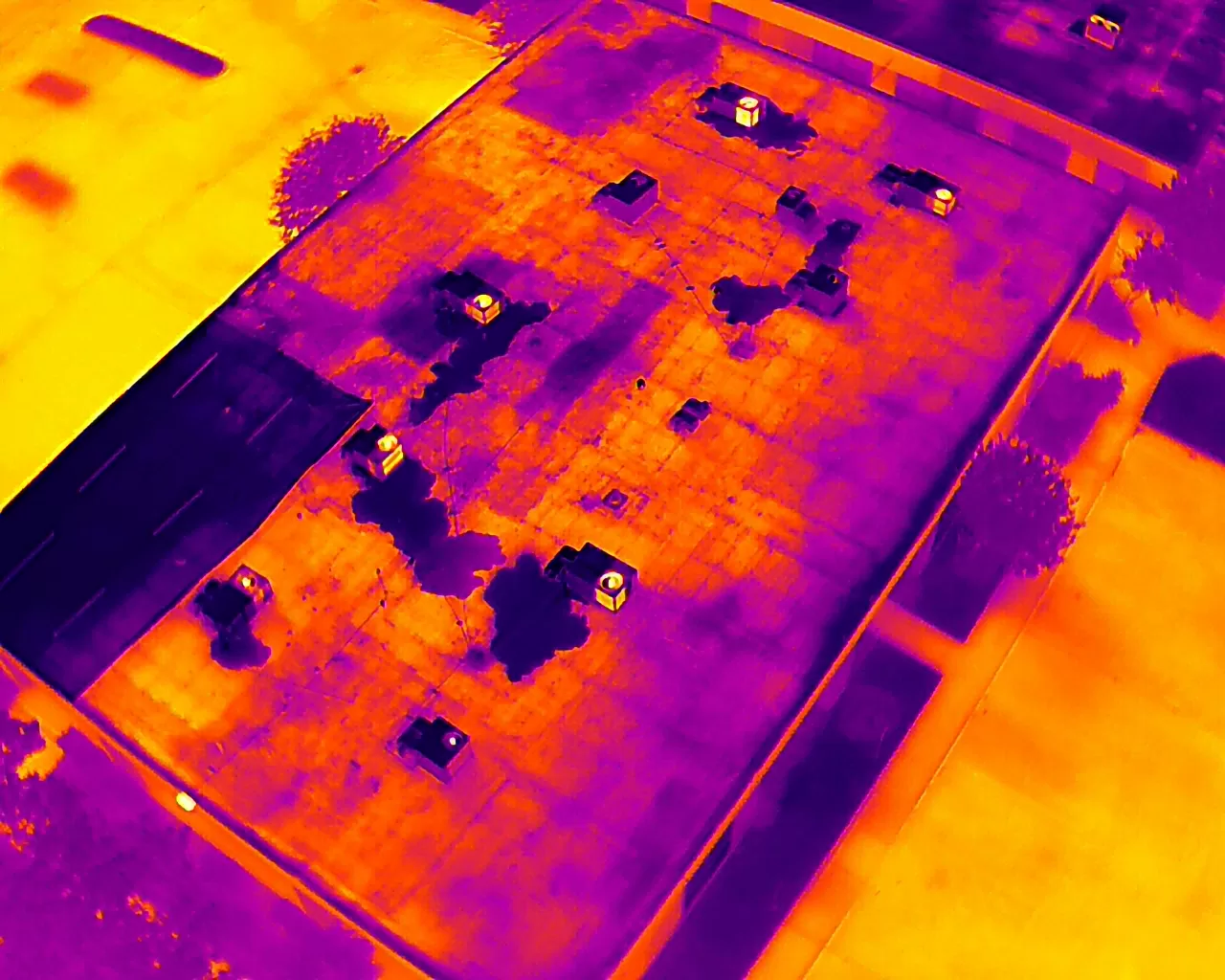
Wet insulation holds heat after sunset; dry insulation releases it. An infrared scan of an Omaha commercial flat roof on a clear evening after a sunny day maps the moisture in the assembly without cutting a single core — then we confirm with cores where the thermal data says to look.
Infrared thermography works on a simple physical principle: wet insulation has a higher thermal mass than dry insulation. During the day, solar radiation heats the roof assembly. After sunset, dry insulation releases that heat quickly and appears cool on an infrared camera. Wet insulation holds the heat longer and appears warm — the thermal signature of retained heat against a cooling background. A thermal scan conducted one to three hours after sunset on a day with sufficient solar gain maps the moisture pattern across the entire roof surface in a single pass.
The result is a heat map of the roof — zones of retained heat that correspond to wet insulation below the membrane, and zones of normal heat release that correspond to dry insulation. That map tells us where to pull cores. Instead of pulling cores on a grid that may miss significant wet zones, we pull cores precisely where the thermal data shows elevated heat retention. The moisture survey is faster, more complete, and produces fewer unnecessary core holes.
We conduct infrared surveys as a standalone service and as the first phase of moisture surveys on large-footprint Omaha commercial buildings where a core-grid approach would require more cores than the budget supports. The survey is delivered as a thermal image report with the heat-retention zones identified and overlaid on the roof plan, paired with a moisture core confirmation report for the flagged zones.
Survey Conditions Required for Infrared Accuracy
Infrared surveys require specific conditions to produce accurate results. Solar gain during the preceding day is required — the sun needs to have heated the roof assembly enough to create a detectable temperature differential between wet and dry zones after sunset. In Omaha, the optimal survey window runs from late April through mid-October when solar angle and day length produce adequate gain. Winter surveys in Omaha's short, low-angle days often produce insufficient differential and are not reliable for moisture mapping.
The survey must be conducted after sunset — typically one to two hours after sunset — when the dry insulation has released its heat and the wet zones retain theirs. Wind events prior to the survey complicate the thermal pattern; wind cools the surface differentially and can mask moisture signatures. Rain in the 24 hours before the survey masks the thermal differential entirely — wet surface conditions from recent rain produce false positive readings across the entire membrane.
Clear sky conditions on the evening of the survey are required. Cloud cover prevents the differential heat release that makes the scan readable. We schedule surveys based on the National Weather Service forecast and rebook without charge if weather conditions on the survey evening make the scan unreliable.
Infrared Survey Procedure on Omaha Commercial Roofs
Pre-survey: we walk the roof in daylight to document obvious surface conditions, note drain locations, penetration locations, and any areas of observed ponding or repair history. The daylight walk produces the base map that the thermal overlay is applied to and identifies any surface conditions — standing water, HVAC condensate discharge, shaded zones under rooftop equipment — that will affect the thermal reading.
Survey: one to two hours after sunset, we conduct the thermal scan in a systematic pass pattern across the roof, capturing thermal images at overlapping intervals. The camera produces a thermal image for each frame — colors corresponding to surface temperature, with warm zones (retained heat) and cool zones (normal heat release) clearly distinguished. We capture both the thermal image and a paired visual image at each frame so the thermal zones can be referenced to physical roof features.
Post-survey: the thermal images are assembled into a composite thermal map of the roof overlaid on the plan. Warm zones are identified, classified by intensity (high confidence wet, moderate confidence, low confidence), and marked for moisture core confirmation. Core pulls are conducted the following morning. The final report presents the thermal map, the core confirmation results, and the moisture survey conclusion.
When Infrared Scanning Is the Right Tool
Infrared scanning is the most efficient moisture survey method on large-footprint buildings where a comprehensive core grid would require 20 or more cores to achieve comparable coverage. The typical North Omaha industrial building or West Omaha distribution center — 80,000 to 200,000 sq ft of flat roof — is an ideal infrared candidate. A thermal scan of the entire roof surface takes two to four hours; the same coverage with a core grid would require 20-30 cores and significant membrane patching.
Infrared scanning is also useful on buildings where the owner wants maximum information before committing to a scope — particularly on roofs approaching the end of warranty where the owner needs to decide between warranty renewal maintenance, a recover, or a full replacement. The thermal map shows the distribution of wet insulation across the full roof, not just the zones where a limited core sample was pulled. That full picture is more defensible in a manufacturer warranty claim and more useful for a capital planning decision.
Infrared scanning is not the right tool on every building. On roofs below 5,000 sq ft, a core survey is typically sufficient and more cost-effective. On roofs with heavy rooftop mechanical equipment that blocks significant portions of the surface, the thermal pattern is disrupted by the equipment's heat signature and the scan coverage is compromised. We assess each building before proposing an infrared survey and recommend the moisture survey method that fits the building and the question the survey needs to answer.
Frequently asked questions
Does the infrared scan damage the roof membrane?
No. The thermal scan is entirely non-destructive — the camera reads the heat signature from the roof surface without contact. The moisture core pulls conducted to confirm the thermal findings do require coring through the membrane, but those cores are patched with compatible membrane material before we leave the roof. The scan itself causes no membrane disruption.
How accurate is infrared scanning for finding wet insulation?
Under the right conditions — adequate solar gain, clear sky, no recent rainfall, conducted within the proper post-sunset window — infrared thermography identifies wet insulation zones with high accuracy. Research and field experience consistently show 90%+ detection rates for wet zones above a threshold saturation level. The core confirmation step we pair with every infrared survey eliminates any zones the thermal data flagged incorrectly and confirms the wet zones the thermal data identified.
Can infrared scanning be done in winter in Omaha?
In a limited way. Nebraska's short winter days and low solar angle often do not produce sufficient differential between wet and dry zones to produce a reliable reading. We evaluate each building's winter survey feasibility based on the specific calendar date, forecast conditions, and roof assembly. For time-sensitive winter moisture assessments, we typically recommend a moisture core survey rather than infrared.
How soon after a major rain event can you conduct an infrared scan?
At least 24-48 hours after surface rain has cleared and the surface membrane has dried. Surface moisture from recent rainfall creates a false positive thermal signature across the entire roof — every area reads as warm because of surface evaporative cooling in reverse. We wait for the surface to dry and the NOAA forecast to show a clear survey evening before scheduling.
Need a moisture map of your Omaha commercial roof before you commit capital?
We will scan the full roof surface with thermal imaging, confirm with moisture cores in flagged zones, and deliver a complete moisture survey report — so the scope you fund reflects what the building actually needs.
Ready to talk through a roof?
Tell us about the building and the roof problem. We'll document it and put a plan in writing — with an honest repair-vs-replace recommendation and no upsell pressure.