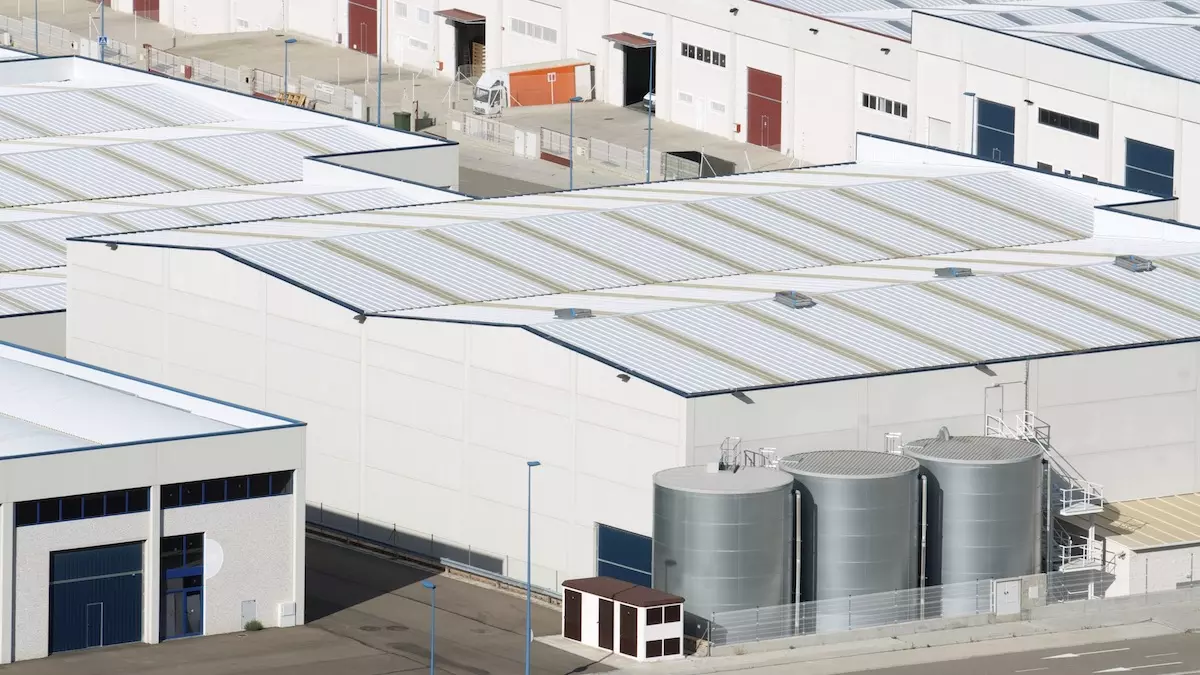
Omaha production facilities, food and beverage manufacturing, and light-industrial buildings in the north Omaha industrial parks and Council Bluffs manufacturing corridor. Chemical-resistant membranes, crane clearance planning, and production-operations coordination.
Manufacturing and industrial roofing in Omaha requires a scope approach that starts with what the building makes, not just what is on its roof. A food and beverage production facility on the north Omaha industrial corridor has rooftop exhaust systems producing grease-laden air that will degrade a standard TPO membrane in five years. A chemical manufacturing or processing building has exhaust emissions that can attack both the membrane and the flashing adhesives. A high-bay production facility with overhead crane rails requires a tear-off and reinstallation plan that keeps crane operations available during the production shift.
The north Omaha industrial parks — running from the near-north side out toward the Eppley Airfield zone — hold the densest concentration of manufacturing and light-industrial buildings in the metro. These buildings range from post-WWII masonry construction with BUR systems that have been patched continuously for 40 years to 1990s-2000s tilt-up construction on first-generation TPO that is now entering replacement cycles. The roof conditions are as varied as the building stock, and a scope that does not account for the building's actual use is a scope that will fail before the warranty expires.
We have serviced manufacturing and industrial buildings in the north Omaha corridor, the Council Bluffs manufacturing district, and the I-80 industrial fringe. Our project managers document the production environment — exhaust content, rooftop equipment type, crane operations, and shift structure — as part of the initial inspection, and that documentation shapes the membrane specification, the attachment method, and the production sequencing plan.
Membrane Selection for Industrial Environments
Grease and chemical exhaust from rooftop ventilation systems is the primary membrane-selection driver on Omaha manufacturing buildings. Standard TPO formulations are not resistant to prolonged grease or chemical exposure — they degrade at the exhaust discharge point and the surrounding membrane field. PVC single-ply membranes are the appropriate specification for buildings with food-production or chemical-processing exhaust: PVC's plasticizer chemistry provides meaningful resistance to grease degradation that TPO cannot match.
For buildings where chemical exhaust content is variable or intermittent, we specify walkway pads and exhaust-discharge protection collars at every rooftop exhaust point, along with an annual maintenance protocol that inspects membrane condition around each exhaust location. This is less expensive than specifying a full PVC system on a building where most of the roof surface has no chemical exposure, and it is more honest than specifying TPO and hoping the exhaust does not reach the membrane.
High-Bay and Crane Clearance Planning
High-bay manufacturing buildings with overhead bridge cranes present a specific sequencing challenge. The crane rail runs to within a few feet of the roof deck in some buildings, and tear-off equipment clearance has to account for crane position. We document the crane rail height, the clearance above the deck, and the crane operating schedule before the production plan is finalized. On buildings where crane access to specific production bays is non-negotiable during the work shift, we sequence tear-off in those zones during shift-change or weekend windows.
Industrial production facilities also have interior environmental constraints that affect what we can open. A clean-room production area, a paint booth, or a food-safe production floor cannot tolerate debris or moisture from an open roof deck — even temporarily. We identify these interior constraints during the inspection walk and sequence production so that sections above sensitive areas are small, fast, and dried-in the same session.
Production Operations Integration
Manufacturing shift structures are more rigid than office or distribution center schedules. A production line that runs a fixed three-shift cycle cannot be moved to accommodate a reroof production window — we move the production window to accommodate the line. We coordinate with the facility manager and production supervisors to identify the hours when overhead vibration, temporary equipment noise, and production sequencing are least disruptive to active lines, and we build the reroof production schedule around that input.
North Omaha industrial buildings on the Eppley-zone open plain carry the same Exposure C wind-uplift requirements as distribution buildings in that corridor. Manufacturing buildings in this zone that were mechanically attached with urban-core fastener patterns are candidates for the same failure mode that the August 2020 derecho exposed in the distribution inventory. We run the uplift calculation from actual exposure conditions on every manufacturing building replacement scope we deliver.
Frequently asked questions
What membrane is right for a food production facility with grease exhaust?
PVC single-ply is the appropriate specification for buildings with food-production grease exhaust. Standard TPO degrades at sustained grease exposure. We specify PVC on buildings where rooftop exhaust contains grease-laden air and include walkway pads and exhaust-discharge collars at every exhaust point regardless of membrane selection.
Can you work around high-bay crane operations?
Yes. We document the crane clearance dimensions and operating schedule before finalizing the production plan. Sections above active crane bays are sequenced to shift-change or non-operating windows. We do not put tear-off equipment in a clearance zone without confirming the crane is locked out for that period.
Our building has been patched for 40 years and we don't know what's underneath the current surface. How do you assess that?
We pull moisture cores in a grid pattern across the roof surface — typically 8-12 cores on a 50,000 sq ft building — to determine how much of the insulation is saturated. We also pull deck inspection ports at any location showing deflection or obvious damage. The core and deck results define the replacement scope before we price the work.
Need a manufacturing or industrial roof scope in Omaha?
We will walk the facility, document the production environment and chemical exhaust conditions, and deliver a written scope with membrane specification and production sequencing centered on your shift structure.
Ready to talk through a roof?
Tell us about the building and the roof problem. We'll document it and put a plan in writing — with an honest repair-vs-replace recommendation and no upsell pressure.