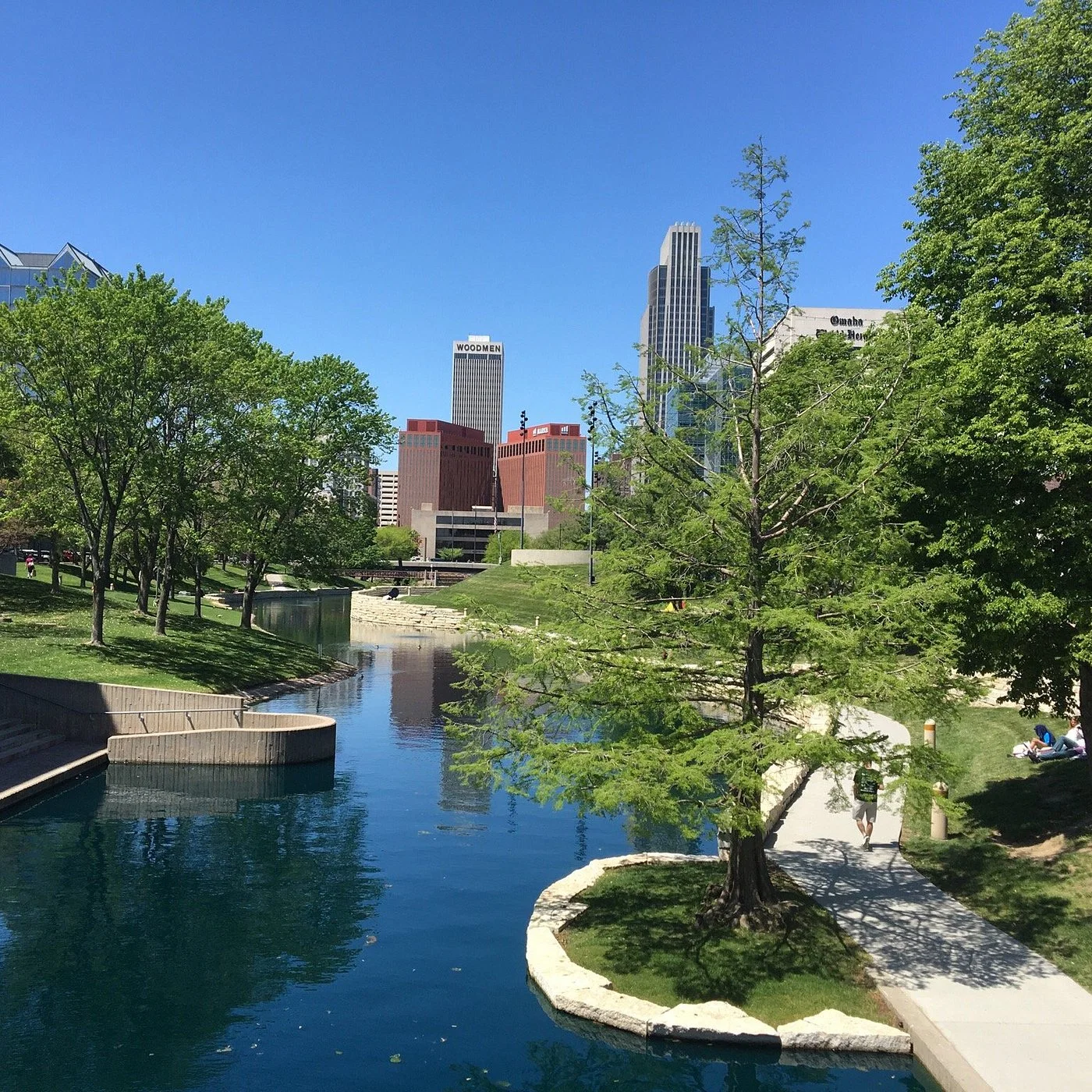
From the Offutt Air Force Base commercial corridor along Capehart Road to the Bellevue Road industrial district and the growing mixed-use inventory along Fort Crook Road — we run inspection routes and emergency response through all of Bellevue's commercial zones.
Bellevue sits at the southern edge of the metro, in Sarpy County, with a commercial inventory shaped largely by its proximity to Offutt Air Force Base. The Capehart Road corridor runs the perimeter of the base and anchors a dense cluster of commercial buildings — office, retail, medical, and service businesses that depend on stable roofs for continuous operations. Fort Crook Road carries the main commercial strip through the city's interior, and the Bellevue Road corridor handles industrial and distribution buildings in the east and southeast.
We service Bellevue out of our office in Downtown Omaha. Travel time to most Bellevue commercial addresses is 25-35 minutes in normal traffic — that puts us on-site same-morning for emergency calls and within the week for planned inspections. Sarpy County permits apply to replacement work in Bellevue; we pull those with the county and with the city's building department depending on scope.
The Bellevue commercial roof inventory spans a wide age range. Buildings along the Capehart corridor built to support base operations in the 1970s and 1980s are running late-generation modified bitumen or first-generation single-ply that is ready for replacement. Newer medical office buildings along Fort Crook Road built in the 2000s and 2010s are entering first maintenance cycles on 60-mil TPO systems. We work both ends of that spectrum.
Offutt AFB Corridor — Capehart Road and Fort Crook Road
The Capehart Road and Fort Crook Road corridors are Bellevue's densest commercial zones. These buildings house defense contractors, medical practices, retail service businesses, and logistics operations that support base personnel. Roof condition in this corridor directly affects lease compliance and operational continuity — a leaking roof on a defense contractor's office building creates documentation and liability exposure that goes beyond a simple repair call.
We document every assessment on Capehart and Fort Crook commercial buildings with a photo-keyed zone diagram and a written condition report. Property managers in this corridor frequently need condition documentation for lease renewals, property insurance adjustments, or capital budget submissions to ownership. We produce reports in a format that goes directly into those processes without the owner having to reformat or interpret contractor notes.
The older buildings in this corridor — particularly those built before 1990 — often carry original BUR or early modified bitumen systems. Some have been patched repeatedly without a documented recover or replacement plan. When we assess these buildings, we include a recover-versus-replace analysis with a rough capital number for each path, so the owner has a decision framework rather than just a list of defects.
Sarpy County Freeze-Thaw and Wind Conditions
Bellevue's climate exposure is identical to the rest of the Omaha metro: 50-70 freeze-thaw events per winter, summer roof surface temperatures above 155°F on dark membranes, and the wind-uplift demands of the open plains east of the Papillion Creek valley. Buildings along Bellevue Road near the Missouri River bottom sit in open-exposure Exposure B or C conditions that require higher fastener density on mechanically attached systems than the more sheltered Capehart corridor.
The August 2020 Midwest derecho crossed Sarpy County at sustained winds above 100 mph. Several Bellevue commercial buildings took membrane damage in that event — mechanically attached systems with inadequate fastener patterns for their actual exposure, parapet coping failures, and rooftop equipment displacement. We inspected and documented several of these buildings in the weeks following the storm. The documentation we produced supported insurance claims and, in two cases, identified pre-existing installation defects that were relevant to the coverage determination.
Annual maintenance in Bellevue focuses on the same failure modes we see across the metro: flashing cracks at parapets and penetrations opened by freeze-thaw cycling, drain blockage from cottonwood seed in late spring, and seam stress on mechanically attached systems at ridgelines where thermal movement is highest. We run maintenance visits in October — before the first freeze — and in April after the last hard freeze, to address both the winter damage and the pre-summer prep.
Emergency Response in Bellevue
The most common emergency calls in Bellevue are drain blockages causing interior flooding, flashing failures at rooftop HVAC curbs during freeze-thaw events, and storm damage following derecho or tornado events. We carry temporary repair materials — EPDM patch, TPO seam tape, silicone repair compound — in service vehicles for immediate dry-in work pending permanent repair scheduling.
Frequently asked questions
Do you pull permits for commercial roof work in Bellevue?
Yes. Replacement work in Bellevue requires permits with the City of Bellevue Building Department. We handle permit applications and inspections as part of every replacement project scope. Repair work below the permit threshold does not require a permit, but we document all repair work regardless.
How quickly can you get to a Bellevue commercial building for an emergency?
Same-day from our office — travel time is 25-35 minutes to most Bellevue commercial addresses. Emergency calls get routed to the closest crew in the field, which can reduce that to 15-20 minutes during business hours.
Can you work on buildings near the Offutt Air Force Base perimeter?
Yes. We work on commercial buildings along Capehart Road and in the surrounding corridor. We do not perform work on the base itself — that requires federal contracting credentials we do not hold. Commercial buildings on private land adjacent to the base are a normal commercial project for us.
Need a commercial roof assessment in Bellevue?
We will walk the roof, document the condition, and produce a written report — usable for capital planning, lease documentation, or insurance support.
Ready to talk through a roof?
Tell us about the building and the roof problem. We'll document it and put a plan in writing — with an honest repair-vs-replace recommendation and no upsell pressure.