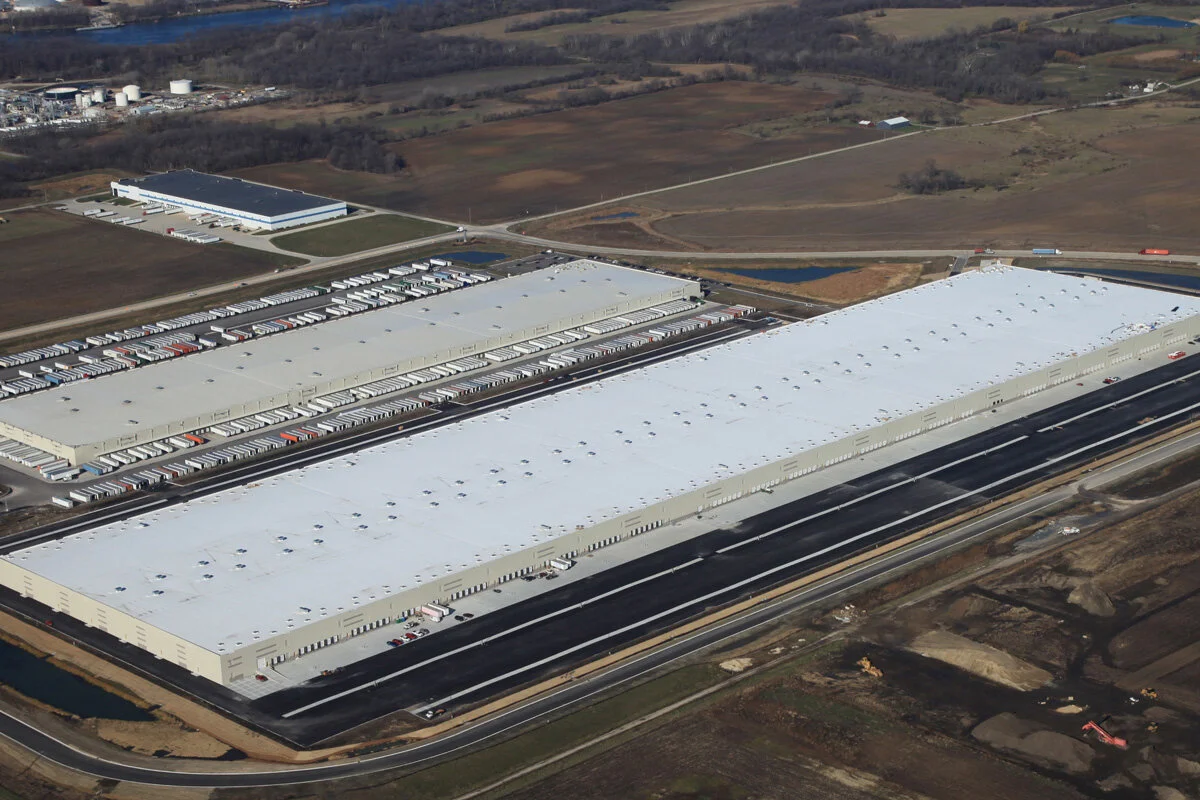
Werner Enterprises headquarters campus, I-80 logistics buildings, and the Council Bluffs cross-river distribution parks. Operations-driven production scheduling, Exposure C wind-uplift engineering, and 20-25 year NDL warranty documentation for institutional logistics facilities.
Omaha is a national logistics hub. Werner Enterprises' headquarters complex at in northwest Omaha anchors a regional transportation and distribution ecosystem that extends to the Council Bluffs industrial parks, the I-80 and I-480 interchange logistics buildings, and the Missouri River-bottom distribution facilities north of downtown. These buildings are larger, operationally more demanding, and more consequential from a wind-uplift perspective than almost any other commercial property type in the metro.
Werner Enterprises' campus is the anchor account in this corridor — a multi-building complex that combines corporate office space, terminal operations, maintenance facilities, and dispatch infrastructure under a single ownership structure with professional facilities management. We maintain roof condition documentation on the Werner campus buildings we have serviced and understand the institutional documentation standard the campus requires.
Distribution center reroofing is primarily an operations coordination problem. A 500,000 sq ft fulfillment building on the Council Bluffs side of the river runs 24-hour receiving and shipping operations. Production sections have to be sized around dock-door windows, trailer staging patterns, and the internal pick-and-pack operation that cannot be disrupted by overhead debris or vibration. We build the production coordination plan before mobilization — the production manager who learns about the facility's operational constraints on the first morning of tear-off has already created problems.
Wind Uplift Engineering for Open-Exposure Logistics Buildings
Distribution centers in the I-80 corridor west of the city and the Council Bluffs industrial parks are in open-exposure conditions — large buildings on flat terrain with no adjacent structures providing meaningful wind buffering. ASCE 7-22 Exposure B or C classification at these sites drives a fastener pattern and membrane specification that is more conservative than urban commercial work. We calculate the wind-uplift requirement for each building using actual exposure conditions and building geometry, specifying a fastener density and membrane attachment method that is designed for the site, not transferred from a standard urban-core template.
The August 2020 derecho that crossed eastern Nebraska at sustained 100+ mph winds is the benchmark event for this corridor. Several distribution buildings in the Eppley zone and Council Bluffs had mechanically attached TPO blow-offs on sections where the fastener pattern was undersized for actual exposure conditions. Insurance claims on those buildings were contested because the undersized installation was a pre-existing defect. We provide forensic documentation that distinguishes storm-caused damage from installation deficiency — and we install systems that will not generate that problem on future events.
24-Hour Operations Coordination
Modern distribution facilities in the Omaha metro — including the e-commerce fulfillment buildings that have opened along the I-80 corridor — run continuous operations with no practical off hours. We coordinate the production schedule with the facility manager before mobilization, identifying the lowest-traffic production windows for loud demo work, the dock-door access zones we cannot block with equipment, and the refrigerated sections that require same-day sealed penetrations.
Material delivery on large distribution buildings requires a designated staging area that does not conflict with trailer traffic patterns. On Council Bluffs industrial park buildings, the truck court activity around the dock doors runs 24 hours — we stage materials at a designated area confirmed with the facility manager and position equipment away from active dock approaches.
Membrane and Warranty Specification for Logistics Facilities
The standard specification for Omaha-area distribution center reroofs is mechanically attached 80-mil TPO over tapered polyiso insulation, with fastener density calculated against the building's actual wind-uplift requirement. 80-mil provides the puncture resistance that a high-traffic maintenance environment requires and unlocks the 25-year NDL warranty path that institutional logistics facility owners typically target.
Tapered insulation is almost always part of the scope on distribution buildings built before 2000. These buildings were constructed to minimum designed slope toward interior drains — a slope that has effectively flattened further as insulation has settled over 25-30 years of thermal cycling. We design the taper package around actual ponding patterns documented during inspection, including the drain locations and their current condition.
Frequently asked questions
How do you coordinate production around a facility running 24-hour receiving and shipping?
We coordinate the production plan with your operations team before mobilization — not on the first morning of production. Dock-door access windows, high-traffic production shifts, staging zone constraints, and refrigerated section sequencing are all documented in the pre-construction plan you review before we start.
What is the wind-uplift design standard for I-80 corridor distribution buildings?
Buildings on open terrain along the I-80 corridor are typically Exposure B or C under ASCE 7-22. We calculate the required fastener density for each building using its actual exposure classification and building geometry. We do not apply a generic urban-core fastener pattern to open-exposure logistics buildings.
Can you provide forensic documentation for a distribution center that had storm damage?
Yes. We provide forensic roof inspections with written documentation that distinguishes storm-caused damage from pre-existing installation deficiencies — the documentation that insurance carriers require to resolve contested claims. We have provided this documentation on Omaha-area distribution buildings following the August 2020 derecho.
Scoping a distribution center reroof in the Omaha metro?
We will walk the full deck, calculate wind-uplift requirements for your building's actual exposure conditions, and deliver a written scope with a production plan coordinated around your operations schedule.
Ready to talk through a roof?
Tell us about the building and the roof problem. We'll document it and put a plan in writing — with an honest repair-vs-replace recommendation and no upsell pressure.