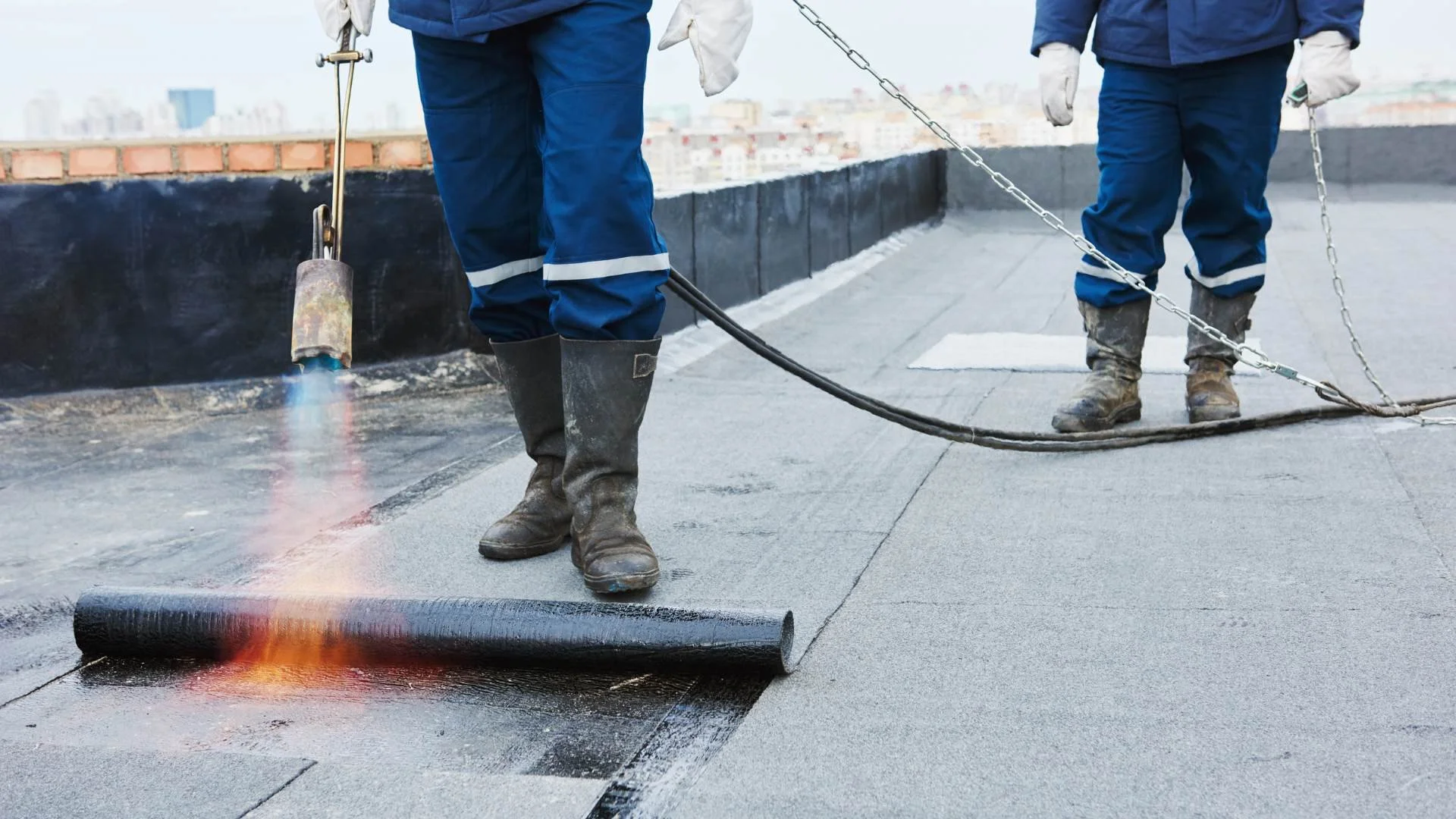
SBS vs. APP in ASHRAE Zone 5A
ASHRAE Zone 5A's heating-dominated, humid continental designation makes SBS the better modified bitumen choice for Omaha over APP. SBS's rubber-polymer modification gives it low-temperature elongation down to -20°F or lower, depending on formulation. APP's plastic-polymer modification performs better in high-temperature environments — appropriate for Zone 2 or 3 climates with hot summers and mild winters, not for the Nebraska thermal range.
In practice, we see APP systems installed in Omaha in the late 1990s and 2000s — contractors brought APP from warmer-climate markets — performing worse at flashings and laps than SBS systems of the same age. The APP membrane at a parapet flashing cycling between -25°F and 100°F becomes brittle at the low end and loses the elongation needed to handle freeze-thaw movement. We find cracked APP flashings regularly on 15-20 year old systems that would still be serviceable with the same maintenance if they had been SBS.
For recover applications over existing BUR or modified bitumen, SBS cold-adhesive systems are the safest choice. Torch-applied SBS over an existing BUR system requires a hot-work permit from the City of Omaha Development Services and careful fire-watch protocol — the asphalt in the existing system can reignite from residual heat. Cold-adhesive or self-adhered SBS eliminates the torch ignition risk entirely and is the system we specify when the building is occupied and the fire-watch requirement is operationally difficult to manage.
Modified Bitumen and the Derecho Wind Record
Modified bitumen performed better than mechanically attached single-ply in the August 2020 derecho on Omaha commercial buildings — primarily because most mod-bit systems are fully adhered or torch-applied to the substrate, giving them higher wind-uplift resistance than a mechanically attached membrane with point-loaded fasteners. The failure mode for mod-bit in extreme wind is parapet blow-off and cap-sheet delamination at laps, not field-membrane blow-off. We documented both on Omaha buildings after the event.
Parapet cap-sheet delamination is the most common mod-bit derecho failure we see. The top cap sheet at a parapet coping is exposed to the highest wind speed on the roof — the parapet acts as a sail, and the cap sheet at the top is peeled from below by negative pressure. Buildings with undersized coping metal or cap sheet that was not embedded fully to the parapet face are the most vulnerable. We replace parapet cap sheets and coping metal to current wind-design standards on every mod-bit project we touch.
Lap delamination at field seams is the second failure mode. Modified bitumen laps depend on full adhesive bond — torch-applied, cold-adhesive, or self-adhered depending on the system. A lap that was not heated to full temperature during torch application, or was cold-adhesive bonded in cool weather with insufficient dry time, will delaminate under wind uplift. We document lap bond quality with probe tests at installation and before closeout.
Freeze-Thaw Cycling and Modified Bitumen Service Life
Omaha's 50-70 freeze-thaw events per winter are harder on modified bitumen than on single-ply membranes because mod-bit is a multi-layer system with lapped seams where water can infiltrate and freeze. A lap seam that admits water — from an incompletely torched edge or a cold-adhesive bond that has aged out — will admit water, freeze the water in the lap, and be forced open by ice expansion in successive winters. Within three to four winters, a lap that was only partially bonded at installation is fully open.
We inspect every lap edge on existing modified bitumen systems during condition assessment, pressing the lap edge and checking for adhesion. Loose laps are a repair scope item when the system is otherwise sound. When laps are loose across more than 30% of the roof area and the insulation shows saturation in moisture cores, we move the scope to recover or replace.
Cap-sheet granule loss is the leading aging indicator on modified bitumen. Heavy granule loss exposes the asphalt matrix to UV oxidation, which accelerates brittleness. Nebraska's UV load — higher than many comparable latitudes due to open plains low humidity — drives granule erosion on south-facing slopes and horizontal field surfaces. We measure granule coverage during inspection and include it in the condition report as a remaining-service-life indicator.
Frequently asked questions
Is torch-applied modified bitumen safe on an occupied Omaha building?
Yes, with proper hot-work protocol. Torch work on an occupied building requires a hot-work permit from the applicable authority, a designated fire watch during application and for 60 minutes after each section is complete, and a pre-construction meeting with the building's facilities management to confirm fire alarm and suppression system status. We have completed torch-applied modified bitumen projects on occupied office buildings along Dodge Street and on occupied UNMC-adjacent buildings — the protocol is documented and followed on every project.
How long does a modified bitumen recover last in Omaha?
A two-ply SBS recover over dry BUR or modified bitumen insulation is warranted for 15-20 years depending on manufacturer and system specification. In practice, we see properly installed SBS recover systems on Omaha buildings perform 20-25 years with annual maintenance. The insulation being dry at the time of recover is the most important variable — a recover over wet insulation will not deliver the warranted service life regardless of membrane quality.
Can modified bitumen be coated to extend its life?
Yes. Silicone or acrylic elastomeric coatings are commonly applied over modified bitumen to extend service life 10-15 years by protecting the cap sheet from UV oxidation and filling minor crack networks. The coating requires a clean, adhesion-tested, and properly primed substrate. We assess coating candidacy during inspection — a membrane with open laps, delaminated seams, or wet insulation is not a coating candidate regardless of how the surface looks. Coating over those conditions traps moisture and accelerates degradation.
Modified bitumen roof on an Omaha building reaching end of life?
We will pull moisture cores, assess lap bond condition, and deliver a written recover-vs-replace scope with SBS system specification and manufacturer warranty path.
Ready to talk through a roof?
Tell us about the building and the roof problem. We'll document it and put a plan in writing — with an honest repair-vs-replace recommendation and no upsell pressure.