A commercial roof leak in Omaha is rarely where the stain appears. The actual entry point can be twenty feet from the interior stain, elevated above it, on a parapet face or a failed flashing that channels water horizontally before it finds a path through the deck. We locate the source before we repair. That distinction is why our repairs last.
Most commercial roof leak repairs in Omaha fail within two years. The contractor shows up, applies a sealant at the most obvious suspect location — the nearby drain, the adjacent penetration boot — and collects a check. The entry point was somewhere else. The interior stain dries, the building owner assumes it is fixed, and then the next spring rain event reopens the same leak path through the same unaddressed entry point.
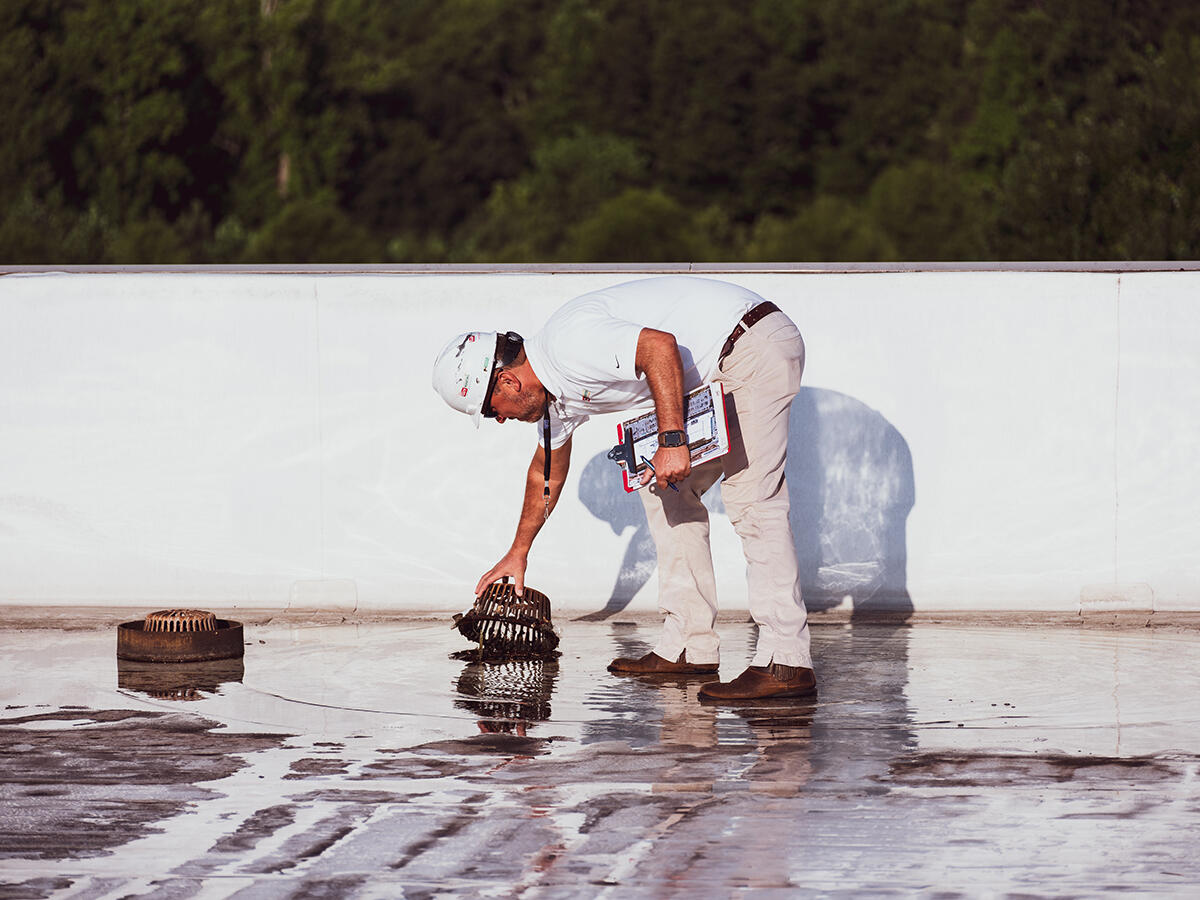
We do not repair until we have located the source. On complex flat roofs with multiple membrane layers, aging flashings, and interior mechanical systems that can transport water horizontally before it drips, source identification takes longer than the repair itself. We use a structured tracing protocol: we walk the area above the interior stain, we inspect every penetration and flashing within a 20-foot radius, we probe suspect seams, and when we cannot identify the source by visual inspection, we use an electronic leak detection (ELD) survey or a controlled water flood test to isolate the entry point.
When we find the source, we document it before we repair it — because the documentation tells you what actually failed and gives you a maintenance record that is useful for the next inspection cycle.
Leak Source Identification on Omaha Commercial Flat Roofs
Penetration flashings: Every roof penetration — pipe stack, conduit, HVAC duct, gas line — has a flashing that seals the membrane to the penetrating element. In Omaha's freeze-thaw climate, the sealant at the top of the flashing cone or pitch pan degrades within five to eight years. We inspect every penetration boot and pitch pan within 30 feet of the interior leak location, probe the sealant condition with a pick tool, and check the flashing membrane for separation from the penetrating element.
Parapet flashing: The base flashing that runs up the face of the parapet wall is the highest-failure-frequency leak source on most Omaha commercial flat roofs. The membrane must be both adhered to the parapet face and mechanically terminated at the top. If the termination bar is loose, if the sealant at the termination is open, or if the base flashing has separated from the parapet face — all common results of Omaha's freeze-thaw cycling — water runs behind the flashing and enters the wall cavity or the roof assembly below.
Seam failure: TPO and EPDM seams that were marginally welded or adhered at installation typically fail within three to six years under Omaha's freeze-thaw cycling. The failure is often at a T-joint or at a seam that crosses a penetration — locations where the welder had to work around an obstacle and where weld quality is most variable. We probe every seam in the area above an active leak with a 5-lb test wheel to identify open seams before we repair.
Temporary Dry-In vs. Permanent Repair
Emergency calls get a temporary dry-in if we cannot complete the permanent repair in the same visit. Temporary dry-in means the entry point is sealed against the next rain event — typically with EPDM patch material, TPO seam tape, or a fluid-applied sealant — while the permanent repair scope is being developed. We do not present a temporary dry-in as a permanent repair, and we give a written estimate for the permanent scope within 24-48 hours of the emergency visit.
The distinction matters because some commercial property owners receive a temporary dry-in and then defer the permanent repair for budget reasons. The temporary material has a defined service life — EPDM patch held with contact cement may last one or two seasons. If the permanent repair is deferred past that service life, the temporary patch fails and the interior is re-exposed. We track temporary repairs we have placed and follow up before the temporary material reaches its limit.
Permanent repair scope for a commercial leak in Omaha typically covers the identified entry point, a 10-foot perimeter around it to address any adjacent deterioration, and a review of the full roof surface for other developing issues that may become leaks before the next inspection cycle. Addressing only the point of failure and nothing adjacent is the approach that produces a callback in two years.
Interior Damage Documentation for Insurance
A commercial roof leak that has been active for more than one rain event typically produces interior damage — ceiling tile staining, drywall saturation, insulation compression, and in some cases, electrical equipment exposure. We walk the interior below every roof we inspect for active leaks and document the interior damage in our inspection report. This interior documentation is necessary for insurance claims that cover consequential damage as well as the roof itself.
On occupied commercial buildings — particularly the medical office and professional office inventory along the 72nd Street corridor and at UNMC — interior damage documentation requires coordination with the tenant and the building's facility management team. We bring a camera and a tape measure, not just a verbal description. The documentation includes square footage of affected ceiling, photographs of affected insulation and drywall, and notation of any electrical or mechanical equipment that was exposed to water.
Frequently asked questions
How quickly can you respond to an active commercial roof leak in Omaha?
Downtown, Midtown, and the 72nd Street corridor get crews within four business hours. West Omaha and Aksarben are same-day. Bellevue and South Omaha are same-day. After-hours and weekend emergency response is available for buildings on our maintenance contracts. Call (402-258-5343.
Can you always find the source of a roof leak?
In most cases, yes. When visual inspection does not isolate the entry point, we use an electronic leak detection survey — a low-voltage current test that identifies breaches in the membrane field without flooding the roof. ELD is accurate to within a few feet for most single-ply systems. On built-up roofing with multiple membrane layers, source isolation can require a controlled flood test. We explain the diagnostic approach before we proceed so there are no surprises on the invoice.
Why does my commercial roof keep leaking in the same area?
Recurring leaks in the same location almost always mean the entry point was not correctly identified — the repair addressed a nearby obvious suspect but not the actual source. The second most common cause is a repair that was applied to the symptom (a wet drain area) rather than the source (a parapet flashing that channels water to that area). Call us for a fresh source-identification inspection — we will approach it as a new problem, not a repeat of the prior contractor's diagnosis.
Active roof leak on an Omaha commercial building?
Call (402-258-5343. We will have a project manager on site within four business hours for most Omaha addresses, locate the source before we repair, and document everything in writing.
Ready to talk through a roof?
Tell us about the building and the roof problem. We'll document it and put a plan in writing — with an honest repair-vs-replace recommendation and no upsell pressure.