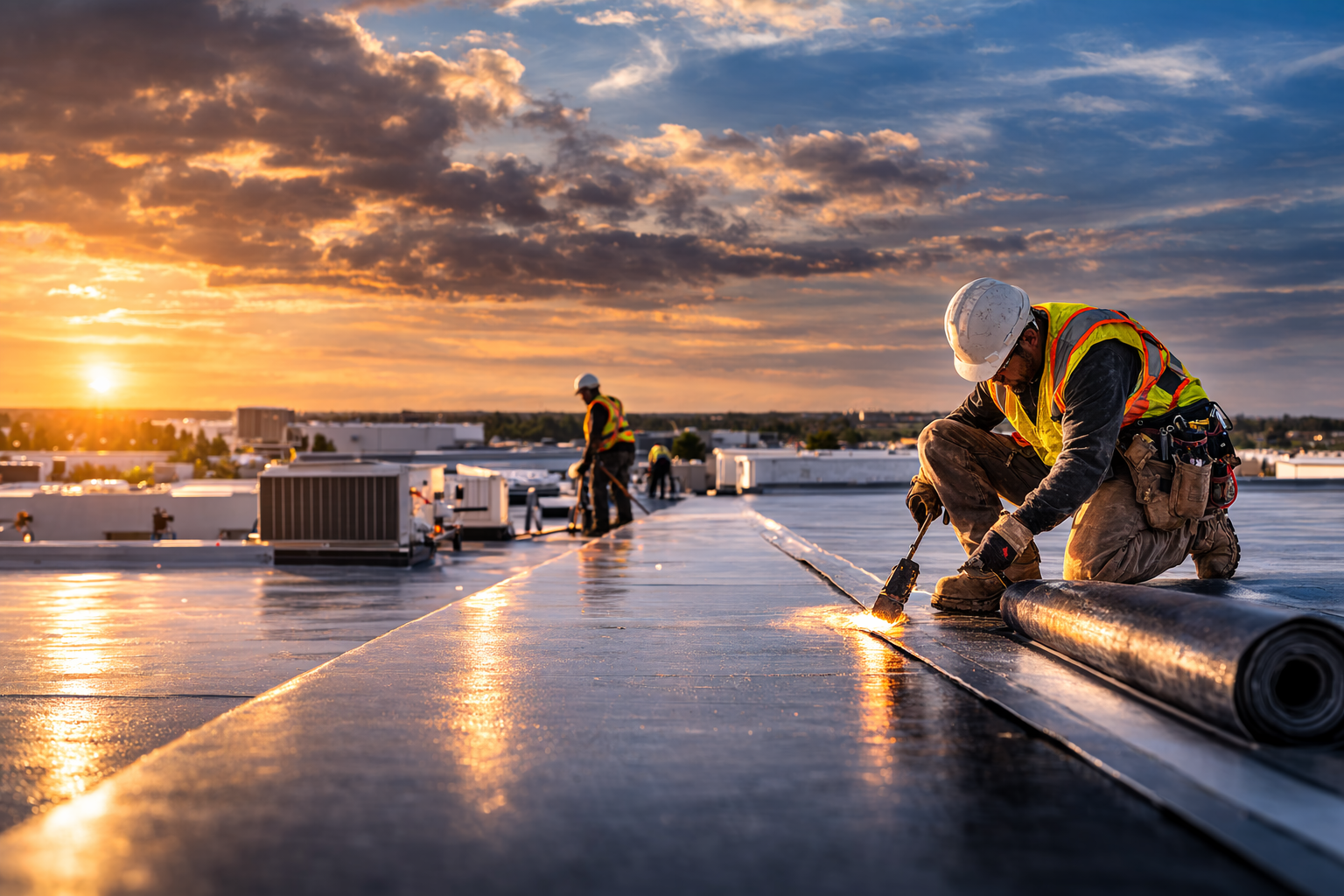
Full-system tear-off and replacement on Omaha commercial flat roofs — scoped against your capital horizon, built to survive Nebraska's freeze-thaw envelope, and closed out with manufacturer warranty documentation that holds up over time.
Most commercial roof replacements in the Omaha metro get scoped reactively. The roof leaks, someone calls three contractors, and the lowest bid wins. That replacement runs the same membrane on the same insulation against the same parapet detailing — and then leaks again in two winters, when freeze-thaw cycling has opened the same flashing cracks the crew never addressed. We do not work that way.
Our replacement scope starts with a roof walk and moisture-core pulls on any roof we suspect has saturated insulation. We document deck condition, parapet flashing condition, drain status, every penetration, and every prior repair. The replacement scope then specifies the membrane, the insulation stack (including R-value to current Nebraska energy code), the fastener density to code wind-uplift, the manufacturer warranty path, and the maintenance contract that keeps the warranty active.
The deliverable at closeout is the warranty document, the roof zone diagram with all closeout photos, the maintenance contract, and a written record the next building owner or capital planner can build against — not a stack of receipts that has to be reconstructed from scratch when the derecho hits.
When Replacement Is the Right Call
Recover-versus-replace is the first decision on any aging Omaha roof. We pull moisture cores in five to ten representative locations on roofs we suspect have insulation saturation. Omaha's climate accelerates saturation: summer humidity from the Missouri River valley drives vapor into roof assemblies, and freeze-thaw cycling then expands that moisture and fractures the insulation. If more than 25% of cores read wet, replacement is the honest scope — recovering wet insulation traps the moisture and voids the new manufacturer warranty. If under 25%, a recover with targeted insulation replacement at wet areas can extend the asset another 15-20 years at roughly half the capital cost of full replacement.
Deck condition is the second decision. We pull deck inspection ports under wet cores and at obvious deflection points. Corroded metal deck or rotted plywood means deck replacement, which moves the project into a different cost band and a different sequencing plan. Building owners need to know this before the project starts — not when the crew opens the roof and stops work mid-project.
What the Replacement Scope Specifies
Membrane: TPO 60-mil or 80-mil for most Omaha commercial buildings — it handles UV exposure, freeze-thaw cycling, and the wind-uplift demands of open-exposure sites on the west side of the metro. EPDM 60-mil where industrial traffic is heavy. PVC 50-mil or 60-mil for restaurants and high-chemical-exposure environments. Modified bitumen for buildings with existing BUR systems where the recover path makes sense economically.
Insulation: We spec to current Nebraska energy code (IECC 2021 minimum R-25 for low-slope assemblies, often higher on buildings with high heating loads in the Nebraska winter). The stack typically runs polyiso primary insulation plus a cover board (HD polyiso or high-density gypsum depending on membrane). Tapered insulation packages are designed against the existing drain layout and the actual ponding patterns documented during inspection.
Fastener pattern: Designed against IBC 2021 wind-uplift requirements for the building's zone and exposure category. West Omaha and the I-680 corridor have open-exposure conditions that push fastener density higher than the protected urban core. Buildings near Eppley Airfield on the open river plain are Exposure C and require the most conservative pattern.
Warranty paths we specify against Omaha buildings: a 20-year no-dollar-limit manufacturer warranty is the baseline target for TPO and EPDM new construction in Douglas and Sarpy County; PVC roofs can carry 25 years on grease-exhaust and food-service buildings where chemical exposure matters; silicone restoration coatings on existing TPO or BUR substrates carry 10, 15, or 20-year terms depending on dry-mil thickness and the moisture-survey result we hand to the coatings manufacturer.
How We Sequence the Project
Pre-construction: Permits filed with the City of Omaha Development Services or applicable Sarpy County / Council Bluffs authority depending on location. Pre-job meeting with the building's facility manager to set crane and material lay-down zones, tenant notification distributed, parking and ingress/egress impact documented.
Production: Tear-off staged in 5,000-10,000 sq ft sections with same-day dry-in on each section — the building is never left exposed to an unforecast rain event. In Nebraska, afternoon convective storms in June-August can develop in under an hour, so we do not let a section go to end-of-day unprotected. Production avoids the coldest months for membrane adhesion work: TPO and EPDM adhesives require substrate temperatures above 40°F for proper bond, which limits fully-adhered work in November-March.
Closeout on every Omaha replacement: we walk the finished roof with the building's facility manager and our project superintendent before the manufacturer's field inspector arrives; the inspector's punch list is closed in writing before the warranty is registered; then we deliver the closeout binder — registered warranty document, photo-keyed zone diagram tied to roof drains and HVAC penetrations, maintenance program agreement, and the manufacturer's commissioning documentation — so the next owner's rep can pick up the asset cold.
Frequently asked questions
How long does a typical Omaha commercial roof replacement take?
For a 50,000 sq ft single-story commercial building with no deck replacement and no major demo: 3-4 weeks of production from tear-off through closeout, assuming normal June-October weather. Nebraska's spring tornado season and summer convective storms can add weather days. We give a written production schedule before contract signing, including identified weather windows.
Will my building be exposed to rain during the replacement?
No. We tear off only what we can dry-in the same day. Each 5,000-10,000 sq ft section gets a temporary dry-in at end of day. Afternoon convective storms are common across eastern Nebraska June through August — we plan production around them, not despite them.
How do you handle rooftop equipment during the replacement?
HVAC units get raised on temporary curbs while we work under them, or they get scheduled into the production sequence so they are worked around without shutdown. Solar arrays require a separate disconnection and reset by a licensed electrician — we coordinate that with your facility's electrical contractor. Communication antennas and satellite dishes used heavily at the corporate campuses along the Dodge Street corridor get temporary bracing plans before any surrounding membrane work begins.
Get a written replacement scope for your Omaha building.
Our project managers will walk the roof, pull moisture cores if the recover-vs-replace decision depends on it, and deliver a written scope detailed enough to bid against.
Ready to talk through a roof?
Tell us about the building and the roof problem. We'll document it and put a plan in writing — with an honest repair-vs-replace recommendation and no upsell pressure.