Roof Systems
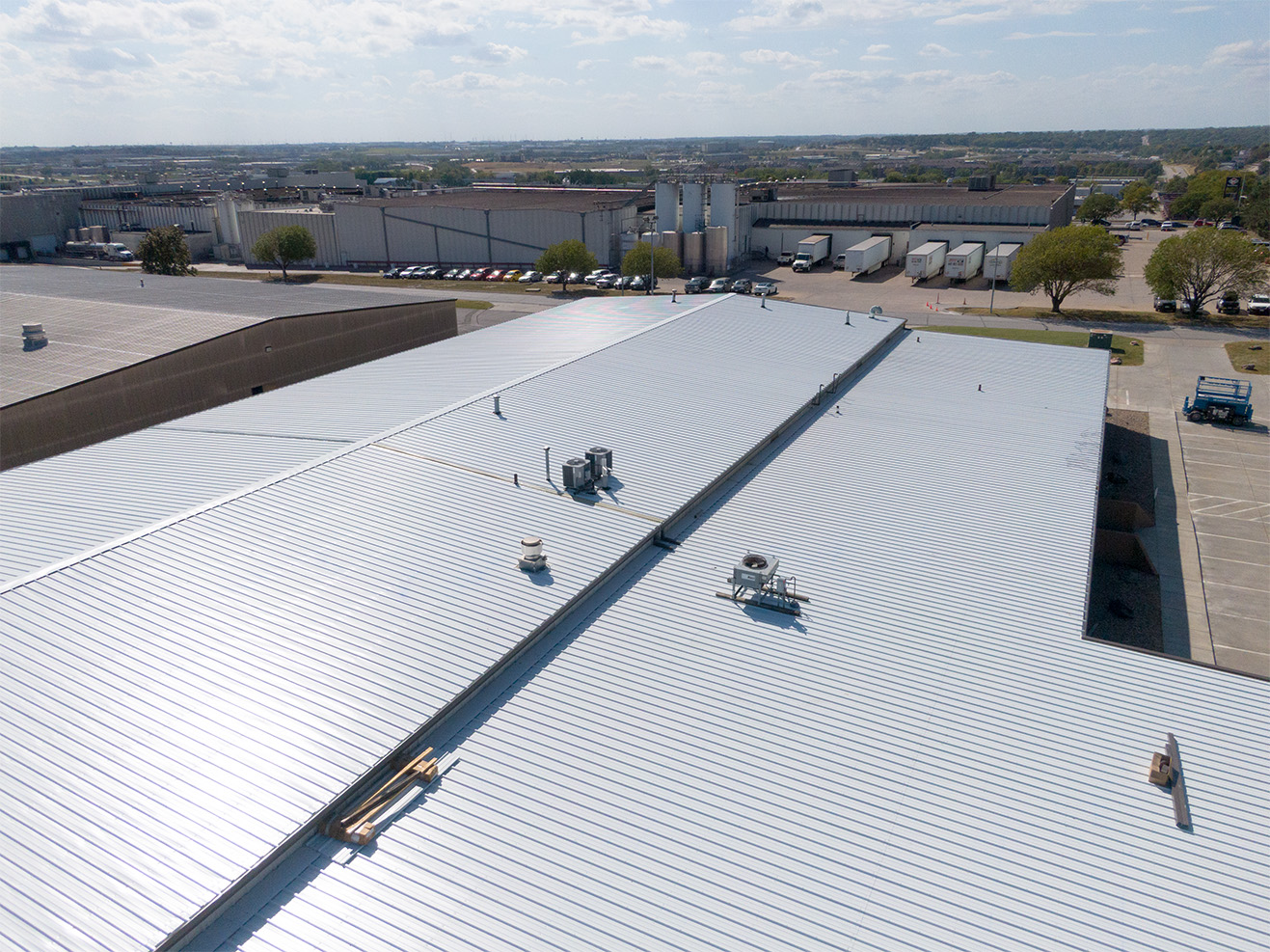
Standing seam metal is the 40-60 year system for Omaha commercial buildings where the capital horizon extends beyond what single-ply membranes can deliver. We install Galvalume steel and aluminum standing seam systems on new construction and as recover systems over existing single-ply and modified bitumen on metal deck.
Standing seam metal is not the right system for every Omaha commercial building, but when the capital horizon and structural capacity support it, it is the system with the lowest 40-year cost per square of any low-slope or steep-slope option. The Werner Enterprises headquarters complex in West Omaha and several of the corporate campus buildings along the I-680 corridor run standing seam metal — not because it was the cheapest option at installation, but because the lifecycle math supported the higher upfront cost when the buildings were being spec'd for 50-year ownership.
The key decisions on a standing seam project in Omaha are panel width and seam height, steel vs. aluminum, and attachment method. These decisions are driven by wind-uplift requirements — post-derecho, we design every Omaha standing seam project to FM Global 1-90 or higher wind-uplift rating using the building's actual exposure category. The August 2020 derecho validated the design: standing seam metal held on every building we have on file where it was installed to correct Exposure C design pressures. Single-ply on adjacent buildings with undersized fastener patterns did not.
Our project managers at , phone (402-258-5343, scope standing seam projects from a structural assessment first. Metal deck capacity and existing insulation condition determine whether a recover-over-existing is viable or whether the project requires a full tear-off with deck replacement.
Derecho Performance and Wind-Uplift Design
The August 2020 Midwest derecho produced the most comprehensive real-world test of Omaha commercial roof wind-uplift performance in the metro's recorded history. Sustained winds above 100 mph and peak gusts over 110 mph at Eppley Airfield loaded roofs at levels that exposed the gap between design wind speed and actual installed capacity on mechanically attached single-ply systems. Standing seam metal, when correctly designed and installed, performed differently: the concealed-clip attachment system distributes load across the full panel length rather than concentrating it at fastener points, and the panel-to-clip connection is designed for the full thermal movement range without loosening over time.
We design Omaha standing seam projects to FM 1-90 minimum wind-uplift rating for most commercial applications, and to FM 1-120 or higher for buildings in Exposure C locations — open terrain, no adjacent structures, near Eppley Airfield or on the open I-680 West Omaha suburban ring. The FM rating drives panel width selection: narrower panels with closer clip spacing deliver higher uplift resistance than wide-bay systems. This is documented in the project specification and confirmed with the manufacturer's technical team before installation begins.
Hail is the second climate event that standing seam metal handles differently than single-ply. The 1.5-2.5 inch hail events that move through Douglas County most springs dent Galvalume steel panels but do not breach them — the membrane is not punctured, and no moisture infiltration results. The same hail event creates puncture risk on 45-mil or 60-mil single-ply membranes, particularly at traffic pad edges and around penetrations. Standing seam metal eliminates hail puncture as a failure mode entirely.
ASHRAE Zone 5A — Thermal Movement and Panel Selection
Omaha's ASHRAE Zone 5A classification drives the standing seam panel selection as much as wind-uplift does. A 40-foot long Galvalume steel panel cycling between -25°F in January and 130°F surface temperature on a July afternoon moves approximately 3/8 inch over that 155°F range. The panel must be free to move longitudinally without binding at the clip or the panel end — a standing seam system installed with fixed clips rather than floating clips will buckle in summer or pull away from the ridge flashing in winter.
We specify floating-clip systems on all Omaha standing seam projects. The clip allows the panel to slide freely over the full thermal range while the clip itself remains fastened to the structural substrate. Panel ends are detailed with a sliding hem at the ridge and a hem with clearance at the eave — the panel never bottoms out against a rigid stop during thermal expansion. This detail prevents oil-canning — the visible waviness that develops in steel panels constrained from free thermal movement — and eliminates the panel-end fatigue cracking that appears in constrained systems after five to ten winters.
Aluminum panels move more than steel over the same temperature range — aluminum's coefficient of thermal expansion is roughly 1.4 times that of steel. We specify aluminum where the weight savings or corrosion resistance justifies the additional thermal movement design work. Buildings near the Missouri River flood zone or in the industrial north Omaha corridor where corrosive atmospheric exposure is elevated are candidates for aluminum. The clip spacing and end-clearance details are adjusted accordingly.
Standing Seam Recover Over Existing Flat Roof
One of the most effective capital strategies for Omaha commercial buildings with aging flat roofs on metal deck is a standing seam metal recover — a structural subframing system installed over the existing flat roof, with standing seam panels fastened to the new subframing. The result is a sloped metal roof over an insulated flat-roof assembly, with no demolition of the existing roof system and no interior disruption to the building's operations.
The structural assessment is the deciding factor. The existing structural framing and metal deck must carry the dead load of the subframing system plus the metal panels plus the design snow load for ASHRAE Zone 5A — Omaha's ground snow load is 25 psf under ASCE 7-22, and the design roof snow load for most commercial buildings is 17-20 psf. We commission a structural review from a licensed Nebraska structural engineer before any recover scope is committed to.
When the structural capacity supports it, a standing seam recover is the highest-value capital decision an Omaha building owner can make on a flat roof that has reached end of life. The installed cost is higher than a TPO replacement, but the 40-50 year service life, the elimination of flat-roof drainage problems, and the avoidance of future flat-roof replacement cycles produce a lower cost per year over the building's remaining life.
Frequently asked questions
What is the typical cost of a standing seam metal roof on an Omaha commercial building?
Standing seam metal installation on a new commercial building in Omaha runs roughly 2-3 times the installed cost of 60-mil TPO per square, depending on panel width, material (steel vs. aluminum), slope, and structural framing requirements. The lifecycle cost comparison flips that ratio over 40 years — standing seam at correct design requires no replacement cycle where TPO requires one or two. We produce a 40-year lifecycle cost comparison as part of every standing seam scope we deliver.
Does standing seam metal hold up to Nebraska hail?
Yes. Hail events in the 1.5-3 inch range that cause significant single-ply puncture damage in Omaha produce cosmetic denting on Galvalume steel standing seam panels without breaching the membrane. The panels do not require replacement after a hail event that would require partial re-roofing on a single-ply system. For insurance purposes, we can document the post-hail condition with photos and a written report — hail dents on steel panels are typically a cosmetic assessment, not a functional impairment.
Can standing seam metal be installed in Nebraska winter?
Yes. Metal panel installation has fewer temperature constraints than single-ply membrane work. There is no adhesive cure requirement and no seam weld temperature requirement. The primary winter concern is ice and snow on the structural substrate during installation, which is a safety and staging issue rather than a product performance issue. We plan winter standing seam projects with ice-removal protocol and worker fall-protection designed for snowed or iced deck surfaces.
Commercial building in Omaha ready for standing seam metal?
We will assess structural capacity, run the wind-uplift calculation from actual exposure conditions, and produce a standing seam scope with 40-year lifecycle cost comparison.
Ready to talk through a roof?
Tell us about the building and the roof problem. We'll document it and put a plan in writing — with an honest repair-vs-replace recommendation and no upsell pressure.