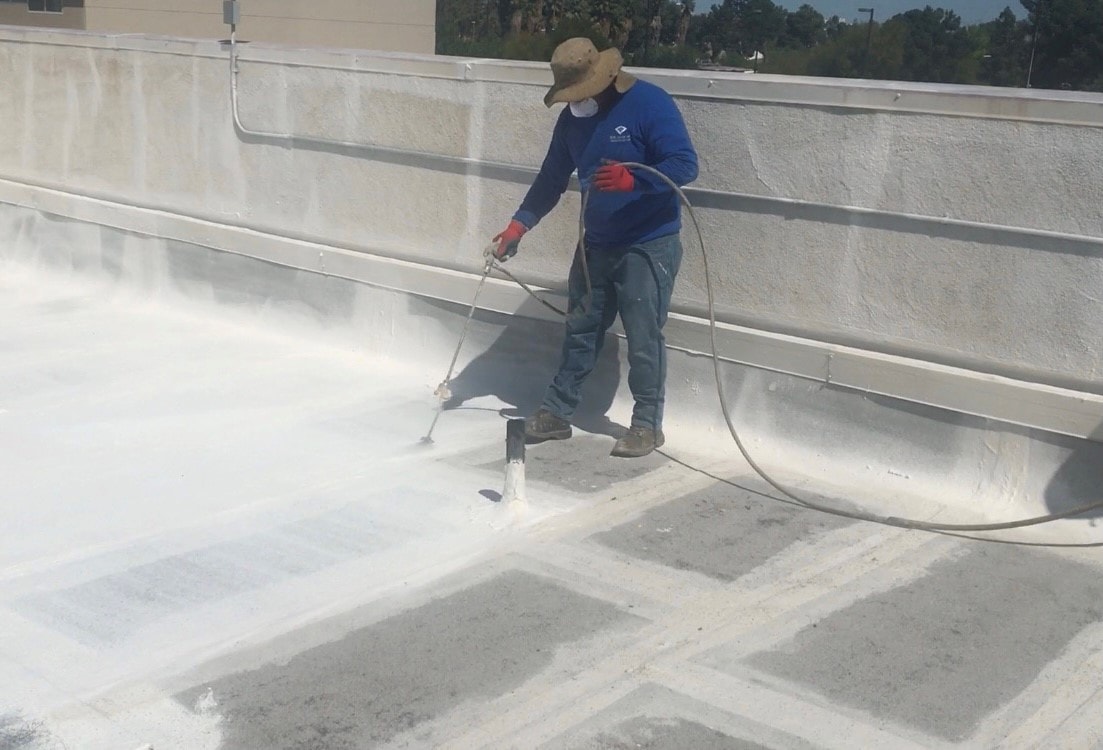
A fluid-applied commercial roof coating installed to manufacturer specification on a properly prepared substrate can extend an Omaha commercial roof's service life by 10 to 20 years with a manufacturer warranty — at 30 to 50 percent of the capital cost of full replacement.
Roof coatings get oversold in the Omaha market. The standard pitch from some contractors is that any aging flat roof can be saved with a coating — which is not true. A coating applied over saturated insulation traps moisture, accelerates insulation degradation, and creates a warranty void the moment the manufacturer inspects the substrate. A coating applied over a membrane that has widespread seam failure or extensive mechanical damage is a short-term cosmetic fix that postpones an inevitable replacement and costs the building owner capital that would have been better applied to the replacement itself.
A coating is the right scope when the substrate passes the inspection threshold: dry insulation (confirmed by moisture core pulls or IR scan), membrane in structurally sound condition with isolated rather than widespread seam failures, and deck in good condition. When those conditions are met, a silicone or acrylic coating installed to the right mil thickness carries a legitimate 10, 15, or 20-year manufacturer warranty and delivers real service life extension.
We install silicone and acrylic restoration coatings from GAF EverGuard, Tremco, Polyglass, and Henry — manufacturer-warranted systems that require a factory inspection and warranty closeout. We do not install commodity coatings purchased at a roofing supply house and applied without manufacturer oversight. The warranty is only as good as the manufacturer standing behind it, and that requires a factory-trained applicator and a factory inspection at closeout.
Silicone vs. Acrylic — Choosing the Right System for Omaha
Silicone coatings are the standard specification for Omaha commercial flat roofs with ponding water concerns. Silicone is fully waterproof when cured, is not affected by ponding water, and remains flexible through Nebraska's full thermal range — from -25°F January lows to 100°F July highs. The Kiewit Plaza and Berkshire Hathaway corporate campus buildings, the UNMC campus research buildings, and the office towers along the Downtown Dodge Street corridor all have flat roof profiles where positive slope is limited and some ponding is normal after heavy rain events. Silicone is the right coating for those buildings.
Acrylic coatings are the right system for buildings with positive slope and minimal ponding — acrylic is less expensive than silicone and delivers excellent reflectivity and UV protection, but it softens and loses adhesion under prolonged standing water. For Omaha industrial buildings with good drainage and slope, acrylic is a cost-effective system. For buildings with the ponding profiles typical of the flat corporate roofs along the Dodge corridor or the warehouse inventory near Eppley Airfield, silicone is the technically correct choice.
Both silicone and acrylic coatings are highly reflective — an Omaha commercial flat roof surface without a coating can reach 155°F in a July afternoon. A white silicone or acrylic coating reduces that surface temperature to 90-100°F, which cuts cooling load meaningfully on buildings where the HVAC is working against a hot roof directly below.
Substrate Preparation — Where Coating Projects Succeed or Fail
Coating adhesion depends entirely on surface preparation. The existing membrane must be clean — free of dirt, debris, ponding algae (common on Omaha roofs that have run years without maintenance), and chalking from UV-degraded membranes. We pressure wash the substrate, let it fully dry (minimum 24 hours in Nebraska's summer humidity, longer in spring and fall), and inspect for residual moisture before coating begins.
Seam repair before coating: Every failed seam and open termination on the substrate gets repaired to manufacturer spec before the coating goes down. Coating over an open seam does not fix the seam — the coating bridges the gap temporarily and then fails at the same location. We document every repair point on the zone diagram and photograph each repair before the coating covers it, so the warranty inspection has a complete record.
The August 2020 derecho left a lot of Omaha commercial roofs with surface damage — bruised membrane, displaced flashing, minor punctures — that made coating work inadvisable until the underlying damage was repaired. Several coating projects that were scoped pre-derecho had to be rescoped after the event. We re-inspect any roof that has been through a major weather event before coating, even if the project was already under contract.
Manufacturer Warranty on Coating Systems
Manufacturer warranties on fluid-applied coating systems require a factory-certified applicator, substrate documentation (moisture core results, IR scan data if required, repair records), factory inspection at closeout, and enrollment in the manufacturer's warranty program. The warranty covers the coating system — labor and materials — for 10, 15, or 20 years depending on the mil thickness installed and the manufacturer.
We are factory-certified applicators for the coating systems we install. The closeout package for every warranted coating project includes the warranty document, the substrate inspection records, the repair documentation, the application log (temperature, humidity, mil thickness at each pass), and the factory inspection report. That package goes to the building owner and is retained in our project file.
Frequently asked questions
Can a roof coating be applied over my existing TPO or EPDM membrane?
Yes — silicone coatings are compatible with TPO, EPDM, modified bitumen, and BUR substrates, provided the substrate is dry, clean, and in structurally sound condition. Compatibility with specific manufacturer systems requires checking the coating manufacturer's substrate approval list. We verify compatibility before specifying a coating system over any existing membrane.
How long will a silicone coating last on an Omaha commercial roof?
A 20-year manufacturer warranty is available on silicone systems installed at the right mil thickness on a properly prepared and documented substrate. Field performance in Nebraska's climate — the freeze-thaw cycling, the UV exposure, the ponding that silicone is specifically designed to handle — typically matches the warranty term when annual maintenance keeps the coating surface clean and any minor coating failures are addressed promptly.
Is a roof coating a cheaper alternative to replacement on a roof that is leaking?
Only if the leak is isolated and the insulation is dry. If cores pull wet across more than a modest area, a coating is not the right scope — you are sealing in the problem. We will tell you honestly which scenario applies to your building after we have walked the roof and pulled cores.
Is your Omaha commercial roof a coating candidate?
We will walk the roof, pull moisture cores if needed, and tell you honestly whether a coating extends the asset or delays an inevitable replacement.
Ready to talk through a roof?
Tell us about the building and the roof problem. We'll document it and put a plan in writing — with an honest repair-vs-replace recommendation and no upsell pressure.