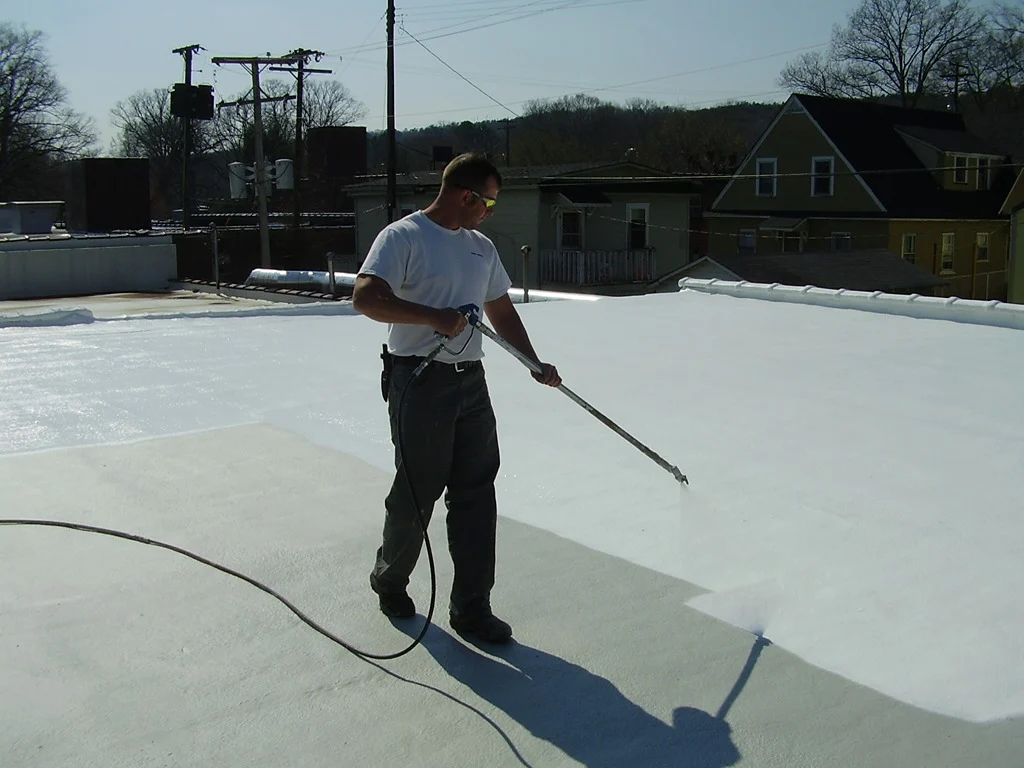
Roof Systems
Spray polyurethane foam creates a seamless, self-flashing, self-draining roof system — no seams to fail in freeze-thaw cycling, no laps to open under derecho wind, and insulation values that exceed what any other roofing system achieves in a single-layer application. We install SPF with silicone protective topcoats on Omaha commercial buildings where the substrate and slope conditions support it.
SPF is a fundamentally different system from every other commercial roofing option — it is applied as a liquid that expands in place to create a seamless, fully adhered insulation and roofing membrane in a single application. There are no seams to probe-test, no lap edges to check for bond, and no fastener plates to verify for density. The system is as strong as the bond between the foam and the substrate — which, on a clean, primed, structurally sound deck, is the deck itself.
The performance advantages in Omaha's climate are specific. Freeze-thaw cycling attacks seams, laps, and terminations on every other roofing system. SPF has no seams. The 50-70 freeze-thaw events per Omaha winter that work open TPO seams and modified bitumen laps have no equivalent failure mode in a seamless SPF system — there is nowhere for water to infiltrate between cycles. Ponding water on flat Omaha commercial roofs is addressed directly by the foam's ability to be tapered to drain at zero added insulation cost — the installer builds slope into the foam profile during application, eliminating low areas without adding structural framing or tapered polyiso.
SPF requires a protective topcoat to resist UV degradation — silicone is the standard topcoat on Omaha commercial installations. The silicone topcoat provides the same ponding-water resistance and freeze-thaw flexibility that makes it the right choice for restoration coatings on other substrates. Call 555-555- to schedule an SPF candidacy assessment.
SPF in ASHRAE Zone 5A — Insulation Value and Energy Code
ASHRAE Zone 5A requires R-25 minimum for low-slope commercial roof assemblies under IECC 2021. SPF at 2.0 pcf density achieves R-6.5 per inch. A 4-inch SPF application — typical for an Omaha commercial building — delivers R-26 continuous insulation with no thermal bridging at fasteners or seams. No other commercial roofing system achieves continuous insulation at this level without multiple material layers: the combination of insulation and membrane in a single application is one of SPF's primary advantages over TPO-over-polyiso or EPDM-over-polyiso assemblies.
The continuous insulation advantage is amplified in Zone 5A's heating-dominated climate. Thermal bridging at fastener plates on mechanically attached single-ply systems creates condensation pathways in winter — warm interior air migrates to the cold fastener plate and condenses on the deck below it. SPF eliminates that pathway entirely: the foam covers the deck uniformly with no penetrations or thermal breaks. Buildings with high interior humidity — food processing facilities, warehouses with refrigerated zones, the UNMC medical campus buildings — benefit significantly from SPF's continuous insulation envelope.
Nebraska energy code compliance is documented in the SPF scope and in the closed-cell foam's R-value per inch — specified in the manufacturer's published data and confirmed by the installed thickness measurement at closeout. We core-sample the installed foam at representative locations to verify thickness meets specification before the silicone topcoat is applied.
SPF and Omaha Derecho and Hail Events
The August 2020 Midwest derecho at 110+ mph gusts was not the first derecho to test Omaha commercial roofs, but it was the most extensively documented in our recent history. SPF systems on Omaha buildings performed well in that event — the fully adhered, seamless system has no point-loaded fasteners and no seam zones to peel. Wind-uplift on an SPF system acts on the foam-to-substrate bond, which is the strongest bond in the assembly. We are not aware of a properly installed SPF system on an Omaha commercial building that experienced wind-uplift failure in the 2020 derecho.
Hail is the primary weather threat to SPF systems in the Omaha market. The same 1.5-2.5 inch hail events that cause TPO puncture can damage the silicone topcoat on an SPF system if the hailstones are large enough and the impact energy high enough. The foam below the topcoat is not breached — SPF is dense enough to absorb hail impact without structural failure — but the topcoat can be dimpled or abraded, exposing the foam to UV. After a significant hail event, we inspect topcoat integrity and recoat abraded areas before UV oxidation affects the foam.
Freeze-thaw cycling has one SPF-specific failure mode worth noting: thermal contraction at the perimeter. The foam shrinks slightly in cold weather, and if the perimeter termination detail is not designed for this movement, the foam can pull away from the parapet or wall at the edge. We terminate SPF at parapets with an L-shaped metal termination bar that accommodates foam movement and then apply the silicone topcoat to bridge the termination — eliminating the edge-separation failure mode.
SPF Application Conditions and Project Sequencing in Nebraska
SPF application is more weather-sensitive than any other commercial roofing system. The two-component foam is mixed at the spray gun and reacts immediately — substrate temperature, ambient temperature, humidity, and wind all affect the foam cell structure and density. Omaha's climate restricts SPF application to a specific window: substrate temperature above 50°F and below 120°F, ambient temperature above 40°F, relative humidity below 85%, and wind speed below 15 mph. In practice, this limits Omaha SPF installation to May through September in most years.
Morning application is standard for Omaha SPF projects — substrate temperatures are within spec, humidity is manageable before the afternoon convective cycle, and winds are typically lowest in early morning. Afternoon convective storms that develop in June through August require monitoring: if a storm cell develops within 30 miles during application, we stop and protect the open foam immediately. Uncoated foam exposed to rain before the silicone topcoat is applied can be damaged and requires re-application in the affected area.
The silicone topcoat is applied within 24 hours of the foam application on every Omaha project — foam left uncoated for longer than 24 hours in Nebraska summer UV begins surface oxidation that reduces topcoat adhesion. We run the foam and topcoat crews on back-to-back schedules with no gaps. The installed foam thickness is core-sampled and documented before the topcoat crew moves onto any section.
Frequently asked questions
Is SPF roofing appropriate for every Omaha commercial building?
No. SPF requires a structurally sound, clean, and dry substrate — it cannot be applied over wet insulation, loose aggregate ballast, or corroded metal deck. It also requires a slope-to-drain path that the foam can enhance but cannot create from scratch: a building with no positive drainage cannot be fully corrected by SPF tapering. Finally, SPF is not the right choice for buildings with very heavy rooftop foot traffic — the silicone topcoat can be abraded by repeated mechanical traffic. We assess each of these factors in writing before recommending SPF.
How is SPF warranted?
SPF manufacturer warranties cover the foam and topcoat system together. 10-year warranties are available from most manufacturers at standard installed thickness. 15-year warranties require additional topcoat thickness. 20-year NDL warranties are available from select manufacturers at maximum topcoat specification and with a maintenance agreement that includes annual inspection and minor topcoat touch-up. We coordinate the manufacturer's warranty inspection and closeout documentation on every warranted SPF project.
What does SPF cost compared to TPO on an Omaha commercial building?
SPF with silicone topcoat typically costs 15-30% more than 60-mil TPO with equivalent insulation on a new installation. The premium is partially offset by the elimination of tapered polyiso as a separate line item — SPF tapering is built into the foam application, while TPO requires a separate tapered insulation package. Over a 20-year lifecycle including maintenance costs, SPF's advantage in energy performance and absence of seam-failure repair costs can close the gap significantly. We provide the full lifecycle cost comparison in every SPF scope we deliver.
Omaha commercial roof with ponding water or insulation deficiency?
We will assess substrate condition, slope-to-drain layout, and foot-traffic profile, and produce a written SPF scope with silicone topcoat specification and manufacturer warranty path.
Ready to talk through a roof?
Tell us about the building and the roof problem. We'll document it and put a plan in writing — with an honest repair-vs-replace recommendation and no upsell pressure.