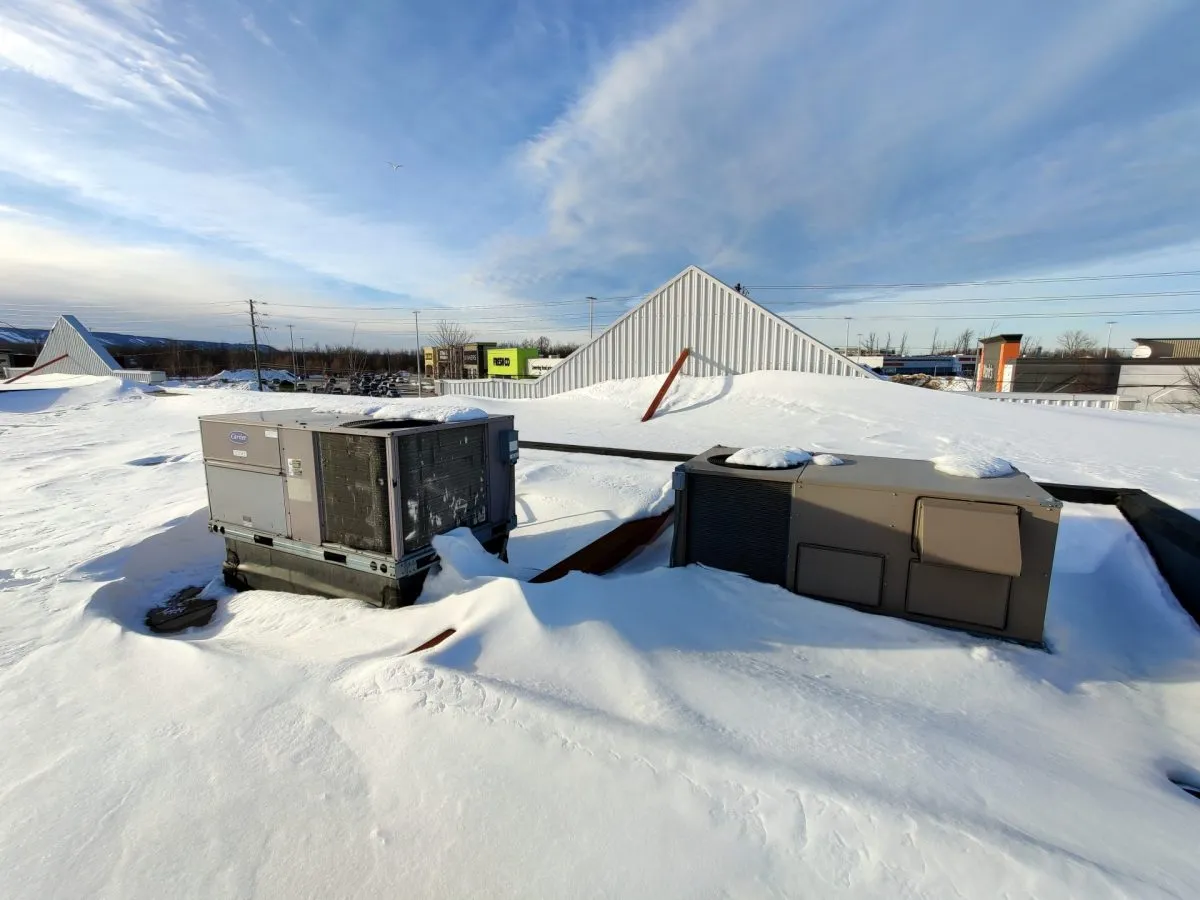
Omaha's ice storms are underrated compared to its tornado and derecho risk, but they cause consistent structural stress and drain failure on commercial flat roofs across the metro. A significant ice event can put 15-20 pounds per square foot of dead load on a roof designed for 10. When that load concentrates at blocked drains, the structural risk is real.
Eastern Nebraska experiences significant ice storms roughly every three to five years. The ice events that affect commercial flat roofs most severely are not always the most publicly visible — the 2009 ice storm that coated trees and power lines across Douglas County received wide attention, but a moderate freezing rain event that deposits a half-inch of ice on a flat commercial roof and then blocks the drains can cause more cumulative structural stress than a more dramatic weather event that melts quickly.
Commercial flat roofs in Omaha are designed to a roof live load standard, and ponding load calculations assume that water drains at a rate consistent with functional primary drains. When drains ice over — as they reliably do in any sustained sub-freezing event with precipitation — water and ice accumulate. If the ice layer is thin and the melt is rapid, the drains clear before structural loading becomes critical. If the ice layer builds over multiple days of sub-freezing temperatures, the structural design margin can be exceeded at drain basins and at low-slope ponding zones.
We have inspected commercial flat roofs after Omaha ice events and found structural deck deflection at drain basins, blocked interior drain leaders that backed water into parapet flashing joints, and ice dam formation at the membrane's perimeter termination where the building's interior warmth met the frozen perimeter condition.
Ice Dam Formation on Omaha Commercial Flat Roofs
Ice dams on commercial flat roofs form differently than the ice dams familiar on residential sloped roofs. On a commercial flat roof, the mechanism is perimeter edge freezing: the membrane surface near the building's perimeter is over unconditioned space and freezes through. The interior field membrane is over the conditioned space and stays slightly warmer, allowing melt. The meltwater migrates toward the drain — which may also be iced over — or toward the perimeter, where it refreezes against the frozen edge. The ice buildup at the perimeter lifts the membrane termination and can push water behind the perimeter flashing.
This failure mode is common on Omaha commercial buildings where the insulation is thinner at the perimeter zone — a frequent condition on pre-2000 construction where tapered insulation at drains was specified but perimeter insulation was standard thickness or thinner. Upgrading the perimeter insulation to reduce the thermal gradient from interior to edge is a mitigation we recommend on any ice-storm-damaged building we inspect.
Buildings near the Missouri River in North Omaha and on low-lying terrain experience longer ice-over periods because cold air pools in low terrain. The distribution buildings and light industrial stock in the North 30th and Abbott Drive corridors have seen repeated ice-dam-related leak events in our project history.
Drain Blockage and Structural Overload Risk
Commercial flat roof drains are typically designed with a primary drain and an overflow drain or scupper at a higher elevation. The primary drain handles normal rainfall. The overflow drain activates when the primary is blocked. During an Omaha ice event, both can ice over simultaneously. When both drains are blocked and freezing rain continues, the only relief path is the parapet scupper — if the scupper is also iced, water and ice accumulate on the roof with nowhere to go.
We assess structural loading risk during post-ice-storm inspections by measuring ice thickness at the drain basins and at the lowest-elevation roof zones, calculating the load in pounds per square foot, and comparing that to the building's design live load. On pre-1980 commercial buildings in Omaha — particularly the flat-roof commercial and industrial buildings along the 24th Street corridor and in the Old Market warehouse district — design live loads can be as low as 10-12 psf. A 1.5-inch ice layer plus residual snow load can exceed that range. We flag this risk in writing and recommend immediate structural consultation when loading calculations approach the design limit.
After drain blockage events, we inspect interior drain leaders for freeze damage. Cast iron interior leaders in older Omaha commercial buildings crack when the column of water inside them freezes and expands. These cracks are not detectable without cutting a ceiling access panel. We include interior drain leader verification as a standard post-ice-storm inspection item.
Repair Scope After Ice Storm Damage
Drain restoration: Blocked drains are cleared mechanically — not with heat cables or chemicals that can damage drain components. Interior leaders are inspected for frost cracks. Overflow drain and scupper openings are verified free of debris and ice. On buildings where primary and overflow drains iced simultaneously, we assess whether the drain height differential and overflow drain sizing are adequate for Omaha's design rain event and recommend upgrade if they are not.
Membrane repair at ice dam locations: Where ice dam formation has lifted the perimeter membrane termination, we remove the termination bar, re-apply the membrane termination with proper flashing membrane, and re-install the termination bar with sealed fastener penetrations. Where the membrane itself has been cut or torn by ice formation, we patch or replace the damaged section and weld full-width seams to the adjacent membrane field.
Insulation assessment: Significant ice events can drive water into roof assemblies at failed terminations and parapet flashing joints. We pull moisture cores at every ice-dam location after the roof has had time to dry — typically 30-60 days post-event. Wet insulation from a winter ice event does not always show immediate structural symptoms but becomes a freeze-thaw damage accelerant through subsequent winters.
Frequently asked questions
Is ice storm roof damage covered by commercial property insurance?
Weight of ice and snow is a standard peril in most commercial property policies. The complication is that ice dam damage — where water infiltrates behind flashings lifted by ice formation — is sometimes characterized by adjusters as a maintenance deficiency rather than a covered peril. We document ice dam formation specifically, including the evidence of membrane lifting and the thermal condition that enabled it, to support the covered-peril characterization.
Should we be on the roof during an ice storm removing ice?
No. Walking a frozen commercial flat roof during an ice event is a fall hazard. If you are concerned about drain blockage or structural overload during an active ice event, call us. We assess loading risk and, in extreme cases, can open an emergency drain path without putting workers on an iced roof surface.
How do we prevent ice storm damage to our Omaha commercial roof?
Three measures reduce ice storm damage risk: first, verify that primary and overflow drains are clear and functional before every winter. Second, ensure the perimeter insulation is adequate to reduce the thermal gradient that enables ice dam formation — this is a capital improvement, not a seasonal maintenance item. Third, heat cables at primary drains are an option for buildings in low-lying terrain where ice-over is a repeated problem.
Ice storm damage inspection for your Omaha commercial roof?
We assess structural loading, drain condition, membrane termination, and moisture intrusion from ice events — and produce a written report for insurance submission or capital planning.
Ready to talk through a roof?
Tell us about the building and the roof problem. We'll document it and put a plan in writing — with an honest repair-vs-replace recommendation and no upsell pressure.