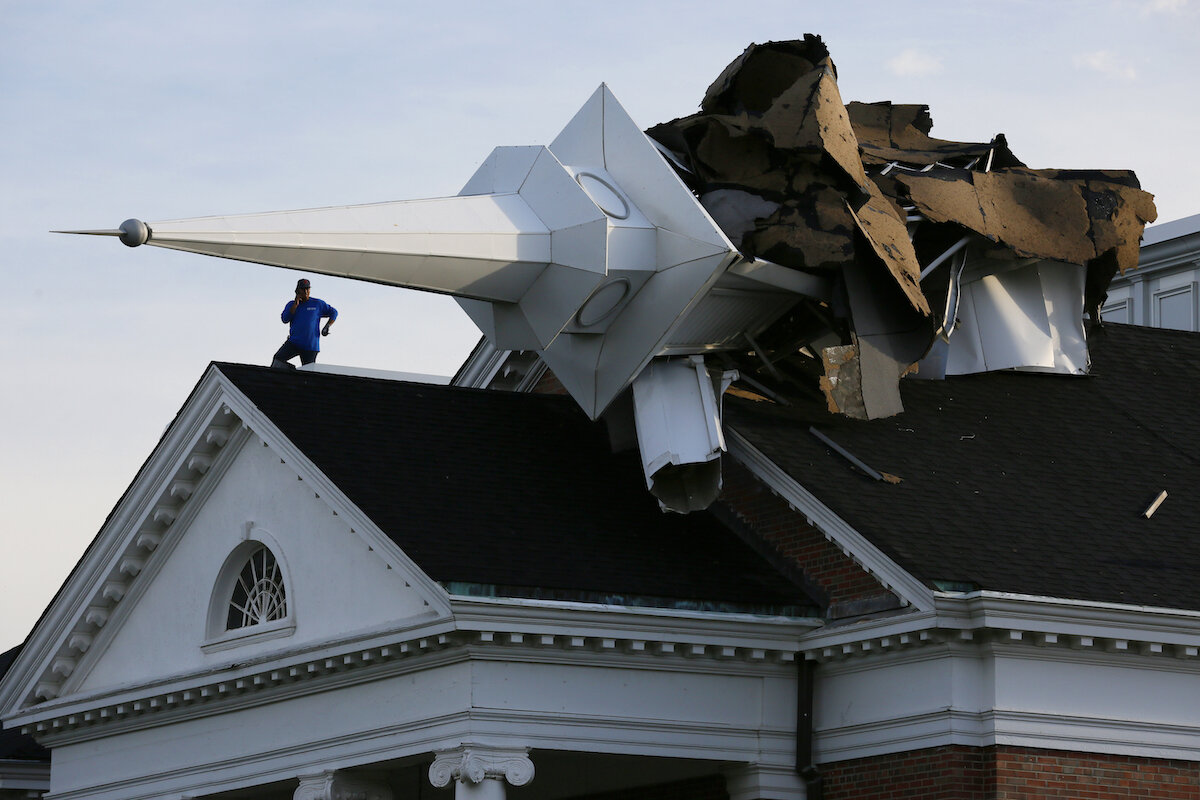
The August 10, 2020 Midwest derecho crossed Douglas County at sustained winds above 100 mph. It was the most damaging wind event in Omaha's recorded history. We documented and repaired roofs on more than a dozen commercial buildings in the weeks that followed — and we learned exactly what failed and why.
The August 10, 2020 Midwest derecho is the defining commercial roof event for Omaha in the last decade. The storm moved northeast across Iowa and into eastern Nebraska as a sustained wind event — not a tornado, not a brief gust, but a wall of 100-plus mph straight-line wind that held for over a minute across open-exposure commercial sites near Eppley Airfield, along the Missouri River bottom, and through the I-680 West Omaha corridor. NOAA recorded peak gusts above 110 mph at Eppley. The destruction was on a scale the metro had not seen from a non-tropical event.
Our crews were on roofs the next morning. What we found across the buildings we inspected fell into three categories: membrane blow-off on mechanically attached systems with undersized fastener patterns, parapet wall failures where unreinforced masonry had no out-of-plane anchorage, and rooftop equipment displacement that created secondary punctures and tears in the field membrane. The common thread was that many of these failures were predictable — and preventable.
We now carry detailed inspection documentation from those post-derecho visits. That record informs how we design fastener patterns on every replacement project in the metro: exposure-rated, not template-copied from a generic spec.
What the August 2020 Derecho Did to Omaha Commercial Roofs
Membrane blow-off: Mechanically attached TPO and EPDM systems depend on a fastener pattern engineered to resist the specific wind uplift the building's exposure produces. Buildings along the Missouri River bottom and near Eppley Airfield are in Exposure C — the most demanding open-terrain classification under IBC wind tables. Several buildings in that zone had been installed with fastener patterns designed for Exposure B, a common error when a national roofing contractor brings a standard spec to an Omaha site without running a project-specific wind uplift calculation. The 2020 derecho found those undersized patterns and peeled back large sections of membrane. We documented entire 10,000-square-foot sections where the membrane had lifted and reseated, with every fastener plate bent upward at the leading edge.
Parapet wall failures: Omaha's commercial building stock has thousands of linear feet of unreinforced masonry parapets — particularly in the pre- commercial corridor, in the Old Market warehouse district, and in the mid-century industrial buildings near the Union Pacific rail yards. The 2020 derecho pushed these parapets from the windward face. Several buildings lost one to two courses of brick across entire parapet runs. Where the parapet cap failed, the roof membrane behind it was exposed, torn, and allowing active water intrusion by the following afternoon.
Equipment displacement: Rooftop HVAC units on inadequate curb anchorage shifted several inches during the derecho. Where the ductwork connection to the curb was rigid, the displacement tore the boot flashing and opened a direct water intrusion path. We found this failure pattern on two distribution buildings near Eppley — the visible exterior damage was minor, but the interior ceiling damage from the resulting leaks was extensive.
How We Document Derecho Damage for Insurance
Derecho roof damage claims require a different documentation package than hail claims. Hail damage is visible at the membrane surface — dents, fractures, granule loss on modified bitumen. Wind damage often shows at the perimeter, at the fastener pattern, and at attachment hardware rather than at the field membrane center. Adjusters who use hail inspection protocols on derecho damage often miss the critical failure modes. We have worked through this mismatch on multiple Omaha claims and know what the documentation needs to cover.
Our derecho inspection document includes: a wind uplift calculation for the building's actual exposure category, a fastener pull-test on a representative sample of the existing field fasteners, a perimeter survey with photo documentation of every lifted membrane edge and bent fastener plate, a parapet survey with structural notation on any displaced masonry, a rooftop equipment anchorage assessment, and an interior ceiling walk to correlate surface damage to specific roof failure points. This package gives the adjuster what they need to evaluate the claim without a second field visit.
One issue that came up repeatedly after the 2020 derecho: when a pre-existing fastener-pattern defect is the root cause of the blow-off, the insurer may attempt to assign contributory negligence to the building owner for deferred maintenance. We document the installation defect separately from the storm event, which establishes that the fastener pattern was a contractor error at original installation — not an owner-maintenance failure. That distinction matters for claim resolution.
Repair Scope After Derecho Damage
Emergency dry-in: The first priority after a derecho event is getting the building weathertight. We carry EPDM patch material, TPO seam tape, and reinforced film tarps in all service vehicles for same-day emergency dry-in. A tarp secured with batten boards over a blown-off membrane section is not a repair — it is a 48-hour bridge to a permanent repair scope. We explain this distinction clearly at every emergency call because some building owners receive verbal repair cost estimates from emergency-response contractors who are actually tarping, not repairing.
Permanent repair: Depends on the extent and mode of failure. Membrane blow-off on a section with otherwise-sound insulation and deck is repaired by removing the lifted membrane, correcting the fastener pattern to the exposure-rated design, and welding a new membrane section with properly lapped seams. Parapet failures require masonry repair and reconstruction before the roof membrane detailing behind the parapet can be restored. Equipment displacement requires the rooftop equipment to be re-leveled, re-anchored, and re-flashed before the curb boot flashing is replaced.
Upgrade versus like-for-like: If the original installation had a defective fastener pattern, a like-for-like repair replicates the defect. We recommend upgrading to the exposure-rated fastener density at the time of the storm repair — especially for buildings in the Eppley Airfield and Missouri River bottom Exposure C zone where the next derecho will find the same weakness.
Frequently asked questions
How quickly can you respond after a derecho event in Omaha?
Emergency dry-in crews are deployed same-day. After the August 2020 derecho, we had crews on roofs the morning after the storm. During an active weather event with widespread damage, response times extend because crews are staged across multiple buildings — we triage by severity of interior exposure risk and dispatch accordingly.
Will my insurer cover derecho roof damage?
Most commercial property policies cover wind damage, including derecho events. The complication arises when the damage was enabled by a pre-existing installation defect — an undersized fastener pattern, for example — which some adjusters characterize as deferred maintenance. We document installation defects separately from storm damage so that characterization can be challenged with written evidence.
What is a derecho, and why is it different from a tornado for insurance purposes?
A derecho is a long-lived, fast-moving line of severe thunderstorms producing widespread straight-line winds. Unlike a tornado, which produces a localized and often small damage footprint, a derecho affects a wide swath — the August 2020 event damaged commercial buildings from Iowa City to Omaha in a single pass. For insurance purposes, both are typically covered under wind damage, but the scope documentation differs because the failure modes are different.
Need a derecho damage inspection and insurance documentation package?
Our project managers will walk the roof, run the wind uplift calculation, pull fastener tests, and produce a written report scoped for insurance submission — not a verbal estimate.
Ready to talk through a roof?
Tell us about the building and the roof problem. We'll document it and put a plan in writing — with an honest repair-vs-replace recommendation and no upsell pressure.