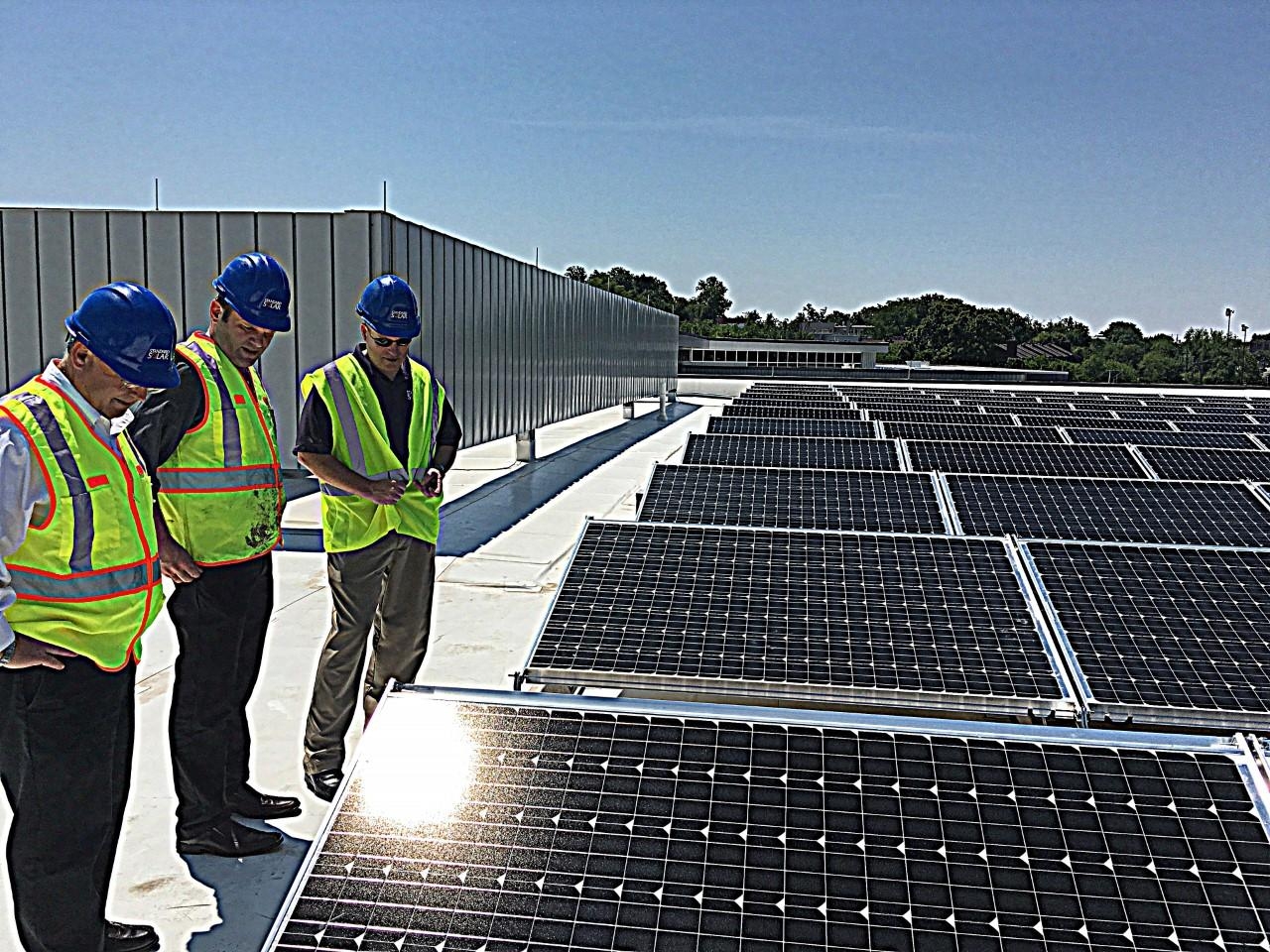
An owner's representative on a commercial roofing project is the person on the building owner's side who can read a manufacturer submittal, identify a flashing detail that deviates from the specification before it goes under the membrane, and communicate a field deficiency to the installing contractor in writing before it becomes a warranty dispute. Without that person, deviations accumulate during production and surface at closeout — or years later when a manufacturer warranty inspection fails.
Most Omaha commercial building owners do not have this capability internally. The facility manager is managing a full building of systems simultaneously. The asset manager is managing capital allocations. The property management team is managing tenant relationships. None of them necessarily knows whether a parapet flashing that does not turn the required minimum onto the vertical face will void the manufacturer warranty inspection — and that is exactly the kind of detail that gets missed without a technical observer on the owner's side of the table during construction.
We fill this role on projects where we are not the installing contractor. The engagement is financially clean: the owner retains us at a fixed fee, we have no financial interest in the installing contractor's work, and our sole function is confirming that the project is installed to the specification, documented accurately, and closed out with manufacturer warranty documentation that will hold up at inspection.
What Owner's Rep Engagement Covers
Pre-construction: We review the contractor's submitted scope, manufacturer submittals, and proposed product samples against the contract documents. On Omaha commercial projects, the pre-construction submittal review is where we most often find scope drift — the submitted membrane product differs from the specified product line, an insulation substitution does not achieve the specified R-value to Nebraska IECC 2021, or the proposed flashing detail is a generic drawing rather than the manufacturer's published Nebraska-climate detail. These get corrected before installation begins, not discovered at the warranty inspection.
During construction: We conduct field observation visits at defined production milestones — insulation installation prior to membrane cover, membrane installation during progress (not only at punch walk), flashing detail completion at parapets and major penetrations, and drain sump installation. Field observation is targeted, not continuous surveillance. The goal is presence at the points where deviations are most common and least correctable after the membrane covers them.
Closeout: We participate in the punch walk, verify that contractor-identified punch items match our field observation records, confirm that the manufacturer warranty inspection is scheduled with the correct credentialed inspector, and review the closeout documentation package — warranty document, photo-keyed zone diagram, maintenance contract, manufacturer start-up form — before the owner accepts substantial completion. Payment recommendation to the owner follows confirmation that the package is complete and accurate.
The Installation Deviations We Find Most Often on Omaha Projects
Parapet flashing turn-down dimension: Most manufacturers specify a minimum height for membrane flashing on the vertical face of a parapet before the termination bar is installed. On Omaha brick parapets where freeze-thaw cycling moves the masonry, the turn-down dimension is the margin that determines whether the flashing accommodates movement or separates from the face. Crews under schedule pressure sometimes install short of the specified dimension. The deficiency is invisible at punch walk once the counterflashing cap is installed.
Fastener pattern at perimeter and corner zones: Mechanically attached TPO on Omaha commercial buildings is designed with a zone-specific fastener pattern — denser at perimeter and corner zones where wind-uplift forces are highest, lighter at the field. The August 2020 derecho exposed this on multiple West Omaha buildings where field-pattern fastener density had been installed uniformly. On owner's rep engagements, we verify the perimeter and corner zone pattern from the approved wind-uplift design, not from the crew's practice.
Tapered insulation as-built vs. design: Tapered insulation packages are designed against the drain layout and the intended drainage slope. In production, a drain that ends up positioned slightly higher than the tapered insulation design assumes creates a permanent low point that ponds indefinitely. We verify the as-built tapered system against the design package before membrane cover. A permanent pond under a new membrane is not a warranty repair — it is an installation defect.
Seam clearance at penetrations: Manufacturer specifications require a minimum distance between heat-welded seams and penetration flashings. When production crews are moving quickly, this clearance gets compressed at high-density penetration zones — HVAC curb fields on Omaha corporate campus buildings, rooftop communication arrays on the North Omaha industrial corridor. The compressed seam leg does not fail immediately; it fails under freeze-thaw cycling over several winters.
When Owner's Rep Engagement Justifies the Cost
Projects above $250,000 installed value generally put enough at risk to justify owner's rep engagement at standard fees. A warranty-voiding installation deficiency on an 80,000 sq ft Omaha commercial replacement means the owner carries an unwarranted roof through Nebraska's freeze-thaw winters for up to twenty years. The cost of field observation on a $400,000 project is a rounding error relative to that exposure.
Buildings with sensitive occupants or operations — Nebraska Medicine and UNMC campus buildings, the financial services campuses along the Dodge Street corridor, data center facilities on the West Omaha corporate ring — have additional urgency. A construction deficiency that produces an interior leak during occupied clinical, financial, or data-processing operations creates liability exposure that exceeds the entire project cost.
Omaha property owners completing their first large commercial roofing project — buyers of acquired buildings, institutional investors new to the Nebraska market — often find owner's rep engagement provides the technical depth they do not yet have internally, while they build the vendor relationships and market knowledge that come with experience in the local contractor pool.
Frequently asked questions
How many site visits does owner's rep typically involve on an Omaha commercial project?
For a standard Omaha commercial replacement of 50,000-100,000 sq ft with 3-4 weeks of production: typically 4-6 field observation visits plus pre-construction submittal review and punch walk. Phased projects, occupied buildings with operational constraints (UNMC campus work, for example, requires pre-construction hot-work plan coordination), and projects requiring deck replacement add visits at the decision points where risk is highest.
Can you serve as owner's rep on a project for which you also wrote the RFP?
Yes. RFP drafting and owner's rep observation are both owner-side roles on projects where we are not in the contractor bid pool. Continuity from RFP through construction reduces scope drift risk because the same technical observer who wrote the specification is verifying installation against it.
What authority do you have on site?
Advisory authority only. We observe, document, and notify — we do not issue stop-work orders to the installing contractor. If we identify a critical deficiency during a field visit, we document it in writing and notify the owner's designated representative immediately with a specific corrective action recommendation. A written deficiency notice from an independent technical observer is typically sufficient to generate contractor response without escalating to a formal dispute.
Do you coordinate with the manufacturer's field rep during the project?
Yes. On projects with active manufacturer warranty paths, we coordinate with the manufacturer's regional field rep to confirm that installation is tracking toward warranty eligibility. For large Omaha projects above $400,000, we recommend requesting a mid-project manufacturer field observation — most manufacturers will accommodate this, and finding eligibility issues mid-project is considerably easier to resolve than finding them at the warranty inspection.
Need a technical owner's rep on an Omaha roofing project?
We will review submittals, observe installation at the milestones that matter, and confirm that the closeout package actually supports the manufacturer warranty your building is paying for.
Ready to talk through a roof?
Tell us about the building and the roof problem. We'll document it and put a plan in writing — with an honest repair-vs-replace recommendation and no upsell pressure.