OMA's terminal expansion and the Offutt AFB complex — home to US Strategic Command in underground facilities with enormous above-grade logistics and maintenance structures — create a distinctive mix of commercial airport and high-security military roofing work in the Omaha metro.
Secondary and Reliever Airports Serving Omaha:
- Millard Airport (MLE) — general aviation reliever on Omaha's southwest side
- Offutt Air Force Base (OFF) — US Strategic Command HQ and E-4B Nightwatch aircraft at Offutt AFB south of Omaha
The roofing systems on airport terminals and aviation support structures carry requirements beyond standard commercial membranes. Jet blast exposure on airside roofs requires membrane adhesion and ballast specifications that exceed what you'd specify for a comparable logistics building. HVAC systems on terminals are denser and heavier than standard commercial, requiring a higher number of curbed penetrations and more frequent flashing maintenance touchpoints. Terminal roofs often span long, flat expanses with minimal slope — which means drainage design is critical and ponding tolerance is near zero. We've done this work, and we don't learn those lessons on your project.
Aviation-adjacent commercial roofing — cargo facilities, rental car centers, FBO hangars, aircraft maintenance facilities, hotel structures on airport campuses — presents a different set of challenges than the terminal building itself, but the airport coordination requirement doesn't go away. Our crews understand that badging and security access at any part of an airport campus is non-negotiable and is planned for, not discovered onsite.
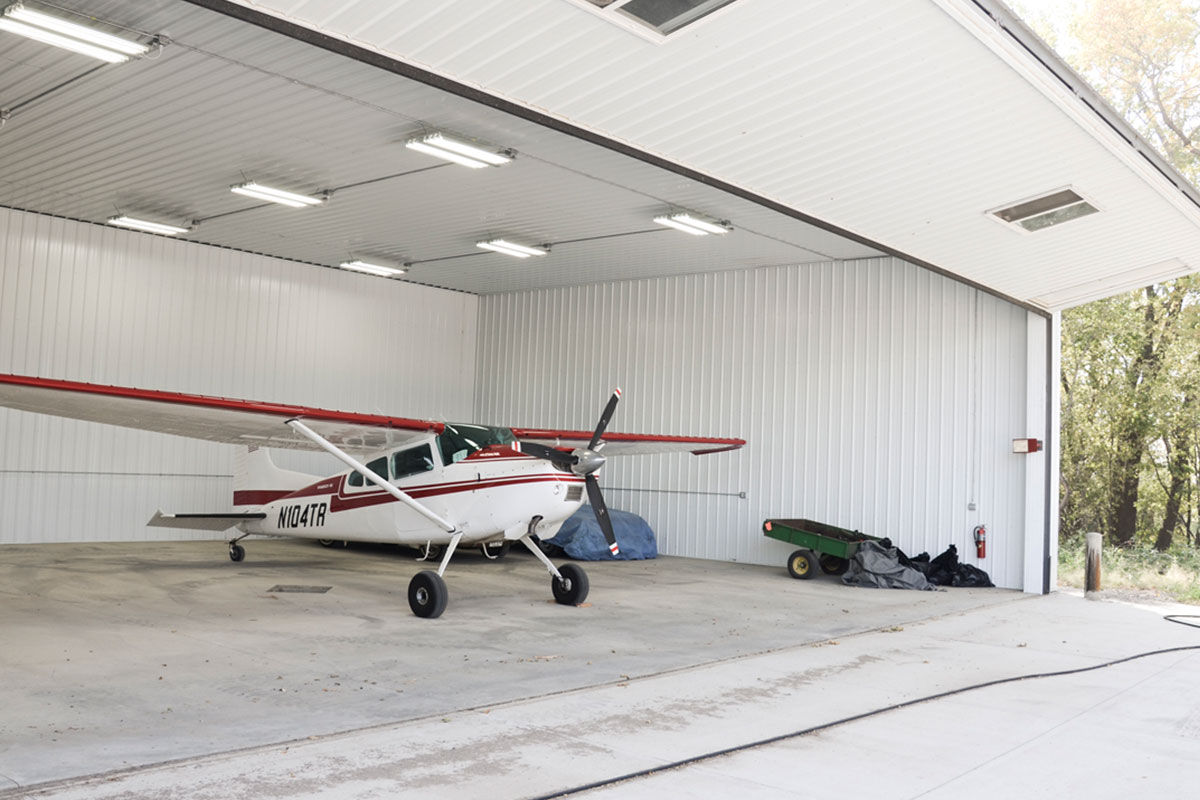
For general aviation facilities — FBOs, private hangars, and reliever airport structures — the security protocols are less intensive but the building type is often more demanding. High-bay hangar structures with large clear-span roofs require specific fastening patterns and seam geometry to handle the wind uplift loads these buildings generate. We spec and install those systems in Omaha and throughout NE.
Airport & Aviation Roofing Questions
We work with the airport facilities department and FAA Part 139 coordinator to develop a phased work plan approved by airport operations. Material deliveries, crane lifts, and any work near airside areas are scheduled during approved windows and coordinated with the FAA NOTAM process if required. We've done this at multiple airports and it's a standard part of our project setup — not an exception.
Most terminal re-roofing in Omaha uses a TPO or PVC single-ply membrane on a tapered insulation system designed to improve drainage and address ponding. For new high-bay aviation structures and hangars, standing seam metal is often specified. The selection depends on the existing deck, load capacity, and operational constraints — we develop a spec after walking the roof with your facilities engineer.
Terminal HVAC density is significantly higher than standard commercial. Our pre-project survey documents every penetration, curb height, and mechanical clearance before we develop the work plan. Flashing details for oversized equipment curbs and complex through-penetrations are engineered individually — we don't use standard residential-pattern flashing details on aviation structures.
Yes, with appropriate badging and in full coordination with airfield operations. Airside work requires a higher level of pre-planning and crew credentialing, which we factor into the bid timeline. We do not mobilize crew members without confirmed airside authorization — that's a baseline requirement we enforce, not a favor we ask.
Yes. General aviation hangar roofing — whether for a single-bay private hangar or a multi-unit FBO complex — is a regular part of our commercial project mix in Omaha. High-bay hangars with wide-flange steel or pre-engineered building systems require roofing contractors who understand those structures' specific uplift and thermal movement characteristics. We do.
The warehouse and industrial inventory around Omaha is concentrated in two corridors. The first runs along the Missouri River bottom north of the downtown core — industrial buildings on the Omaha side near Eppley Airfield and the open river plain, and the Council Bluffs distribution parks on the Iowa side of the river. The second is the I-80 industrial corridor west of the city, where logistics buildings have been added steadily since the mid-1990s. Both corridors have their own roofing problems, and we have worked in both.
The river-bottom and Eppley zone is Exposure C wind territory. Buildings here sit on flat, open ground with no adjacent structures to buffer wind load. The August 2020 derecho crossed this corridor at sustained winds above 100 mph and documented peak gusts above 110 mph at Eppley. We inspected and repaired roofs on more than a dozen Omaha-area buildings in the weeks after that event, and the pattern was consistent: mechanically attached TPO systems specified with urban-core fastener patterns failed under open-exposure conditions. We correct this on every replacement project in this zone by running the wind-uplift calculation from actual exposure conditions and building geometry, not a generic fastener template.
Large-deck warehouse roofing is also a production sequencing problem. A 400,000 sq ft distribution center on the Council Bluffs side of the river cannot absorb a rain event on an open section. Nebraska's June-through-August convective storm season means afternoon thunderstorms can build in under an hour. We plan daily production sections that can be dried-in before crew departure, and we communicate the section boundary to the facility manager before mobilization, not on the first morning of production.
Membrane Specification for Open-Exposure Nebraska Warehouses
Our default specification for Omaha-area warehouse reroofs is mechanically attached 80-mil TPO over tapered polyiso insulation. The 80-mil thickness provides meaningful puncture resistance on roofs with high maintenance-traffic density — condenser cleaning crews, dock-door electrical work, and rooftop HVAC servicing all add up on a large distribution building. The 25-year manufacturer warranty available on 80-mil systems from Carlisle, Johns Manville, and Versico is also relevant for buildings approaching a capital planning or ownership-transition window.
Fastener density on mechanically attached systems in the river-bottom and Eppley corridor is calculated against ASCE 7-22 wind-uplift requirements for Exposure C. The result is a denser fastener pattern than buildings in the sheltered Downtown or Midtown core. We run this calculation for each building using the actual exposure conditions and building geometry — the fastener pattern on a 30-foot-tall open-face distribution building along Abbott Drive is not the same as the pattern on a building screened by adjacent structures in a West Omaha business park.
Tapered insulation is part of most warehouse replacement scopes in this inventory. River-bottom industrial buildings from the 1980s and 1990s were built to minimum slope toward interior drains that have partially blocked over 30 years of sediment accumulation. We design the taper package around actual ponding patterns documented during inspection, not a standard slope drawing applied regardless of where the water actually goes.
Operations Coordination on Council Bluffs and Eppley-Zone Facilities
Distribution facilities in the Council Bluffs industrial parks and the north Omaha logistics corridor typically run two-shift or continuous operations. We coordinate production windows with the facility manager before mobilization and build the production schedule around shipping windows, dock-door peak hours, and any refrigerated zones that cannot tolerate an open penetration overnight. On refrigerated distribution buildings, we plan section sizes that allow same-day sealing on every penetration before crew departure — this adds cost to the daily production rate but is not negotiable on cold-storage work.
Rooftop equipment density on large distribution buildings drives flashing labor more than the field membrane work. A 300,000 sq ft building may have 30 to 50 HVAC units, multiple exhaust stacks, and fire-suppression risers running through the deck. We document every penetration during the inspection walk and include a full flashing rebuild at every penetration in the replacement scope. Partial flashing replacement on a large-deck warehouse is how reroof projects generate leak callbacks within two years.
Post-Storm and Insurance Documentation
The August 2020 derecho created significant insurance claim activity on Omaha-area warehouses. Several claims were complicated because the membrane blow-off was partly attributable to pre-existing underspecified fastener patterns — an installation defect, not storm damage — and insurance carriers pushed back accordingly. We provide forensic roof inspections with written documentation that distinguishes storm-caused damage from pre-existing conditions, which is the documentation that resolves those disputes.
For any warehouse building in the Eppley-zone or river-bottom corridors that has not had a post-derecho inspection, we recommend scheduling one before the next severe weather season. Marginal fastener patterns that survived 2020 are not guaranteed to survive the next open-exposure wind event.
Frequently asked questions
Can you work around 24-hour distribution operations?
Yes. We coordinate production windows with your operations schedule before mobilization — we know which shifts are highest-traffic, where the cold-storage zones are, and when dock-door activity peaks. Production sections are sized so that every open penetration is sealed before crew departure, regardless of what it does to the daily square-foot output.
What wind-uplift standard applies to buildings near Eppley Airfield?
Buildings on the open river plain near Eppley are Exposure C under ASCE 7-22. That classification drives a higher required fastener density on mechanically attached systems than sheltered urban buildings. We run the uplift calculation for each building using actual exposure conditions — not a template.
How do you handle the scale of a 300,000 sq ft reroof?
We stage in daily sections with same-day dry-in on each section. A 300,000 sq ft job typically runs 6-10 weeks depending on equipment density, deck condition, and refrigerated zone sequencing. You receive a written zone-by-zone production schedule before contract signing.
Get a warehouse roof scope for your Omaha-area distribution facility.
We will walk the full deck, document penetrations and wind-exposure conditions, and deliver a written scope with a production phasing plan centered on your operations schedule.
Ready to talk through a roof?
Tell us about the building and the roof problem. We'll document it and put a plan in writing — with an honest repair-vs-replace recommendation and no upsell pressure.