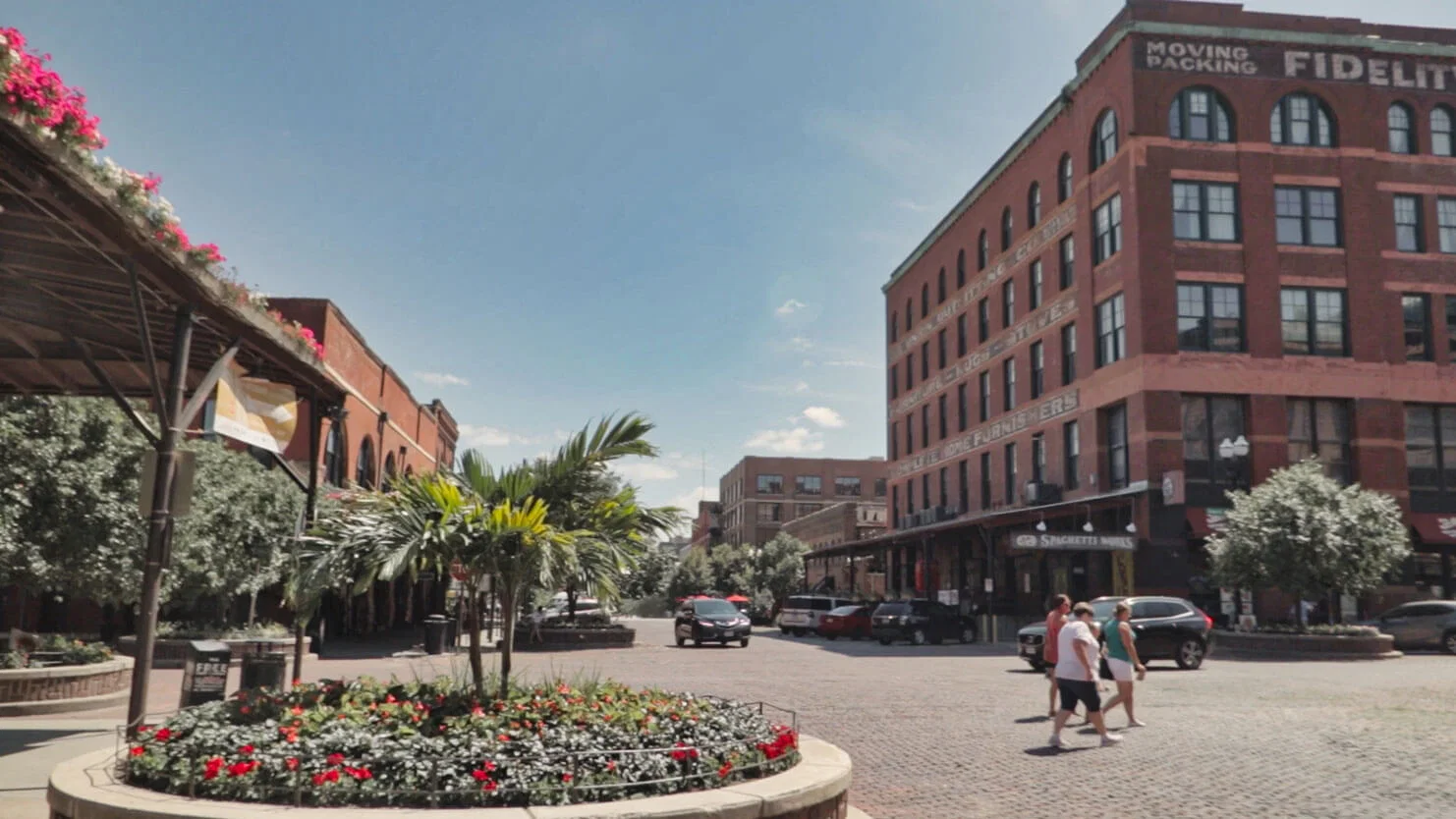
Old Market warehouse buildings are structurally demanding roof projects — party walls, aging masonry parapets, no on-site laydown space, and occupied retail and restaurant tenants on the floors below. We scope these projects the way they have to be done, not the way a suburban TPO contractor would approach them.
The Old Market district runs roughly from 10th to 13th Streets between Farnam and Jackson. Most of the buildings are late-19th and early-20th century brick warehouse construction — heavy timber or steel-and-masonry frames, flat or near-flat roofs, parapets that have been through a century of Nebraska freeze-thaw cycling, and interior drainage systems that were designed before modern roof drain standards existed.
We work in the Old Market regularly. The scale of the buildings is manageable — most are four to eight stories with rooftop square footage in the 5,000-15,000 sq ft range per building. The complexity is in the details: masonry parapet condition, existing drain outlet locations and whether they can handle modern flow rates, party walls with adjacent buildings where our flashing terminations have to tie into someone else's roofline, and occupied ground-floor tenants whose deliveries and customer access we cannot block during a project.
What Makes Old Market Roofs Different
Parapet condition is the first thing we assess on any Old Market building. A masonry parapet that has been through 120 Nebraska winters has experienced significant freeze-thaw movement. Brick faces spall. Mortar joints open. Coping stones shift. A new roof membrane terminated at a failing parapet will fail at the termination — sometimes within one winter. We document parapet condition in the inspection report and include masonry repair in the replacement scope where needed. We do not sign a manufacturer warranty on a building where the parapet is failing and the masonry is outside our scope.
Interior drainage is the second. Old Market buildings were designed with interior drains that run through the floor system — there are no exterior scuppers or overflow drains on most of them. A blocked interior drain on a flat-roofed Old Market building in a heavy rain event can pond two to four inches of water on the roof before it finds another outlet. We camera-inspect the drain lines we can access and test drain capacity before we close out any Old Market replacement project.
Tenant coordination is the third. The Old Market's ground-floor retail and restaurant tenants depend on continuous delivery access through the alley system between Howard and Harney. We schedule material delivery, tear-off debris removal, and equipment staging to keep the alley clear during business hours. Pre-construction notification goes to every ground-floor tenant in the building and to adjacent building operators whose alley access we share.
Typical Scope on Old Market Buildings
Most Old Market buildings we access are on built-up roofing or modified bitumen that is at or past its design life. The replacement path is typically a two-ply modified bitumen or a 60-mil TPO mechanically attached system over polyiso insulation on the existing deck — after deck inspection and any needed deck repair. Fully adhered TPO is sometimes the right choice where the deck cannot accept additional fastener penetrations or where the parapet detail requires the cleaner termination that a fully adhered membrane allows.
Historic preservation requirements apply to some Old Market buildings if they are individually listed on the National Register of Historic Places or are contributing structures within a historic district boundary. We identify preservation status before writing a scope and consult with the building owner's architect or preservation consultant where required. Most preservation restrictions on commercial buildings in the Old Market focus on exterior masonry and visible facade elements — the roof membrane and flashing are generally not visible from the street and do not trigger review — but parapet coping and any roof-edge metal that is visible from adjacent buildings can be subject to review.
HVAC access during replacement is a recurring issue. Most Old Market buildings have rooftop HVAC equipment that serves occupied floors. We sequence rooftop equipment around the production plan: HVAC is not shut down for more than the time needed to work directly under it, and we give the building's mechanical contractor advance notice of the shutdown window so they can schedule accordingly.
Emergency Response and Storm Impact in the Old Market
The Old Market is four blocks from our office. Emergency response to an Old Market building is faster than to any other location in the metro — our project managers can walk to most Old Market addresses. Emergency calls get a crew on-site within two hours, often faster during business hours when we have people in the building anyway.
The Old Market's masonry parapets are the most vulnerable component in a significant wind event. The August 2020 derecho produced wind gusts that displaced brick coping on several Old Market buildings and opened flashing terminations that had been acceptable before the event. We documented and repaired storm damage on buildings in this district in the weeks following the event. If your building is in the Old Market and has not had a documented roof and parapet inspection since August 2020, that inspection is overdue.
Frequently asked questions
Can you work on a building where the ground-floor tenants stay open during the project?
Yes, and most Old Market projects run this way. We sequence tear-off debris removal, material delivery, and equipment staging to avoid blocking tenant entrances and the alley delivery routes. We distribute a pre-construction notice to every ground-floor tenant in the building at least one week before mobilization.
Do Old Market buildings have historic preservation restrictions that affect the roof?
Some do. We check preservation status before writing a scope. Most restrictions on Old Market commercial buildings focus on visible facade elements — the roof membrane and insulation are generally not subject to review. Parapet coping and visible roof-edge metal can be subject to review on individually listed buildings. We identify this early so the owner can get preservation review scheduled before we mobilize.
How do you handle the narrow alleys and no laydown space?
We stage a roll-off dumpster in the alley under a temporary use permit from the City of Omaha, time debris runs for off-peak hours, and deliver materials in smaller loads rather than full semi-loads that cannot navigate the alley width. Material is staged on the roof in manageable sections rather than palletized on the ground.
Old Market building with a flat roof that needs attention?
We inspect, scope, and replace Old Market commercial roofs — with the parapet, drain, and tenant-coordination planning that these buildings require.
Ready to talk through a roof?
Tell us about the building and the roof problem. We'll document it and put a plan in writing — with an honest repair-vs-replace recommendation and no upsell pressure.