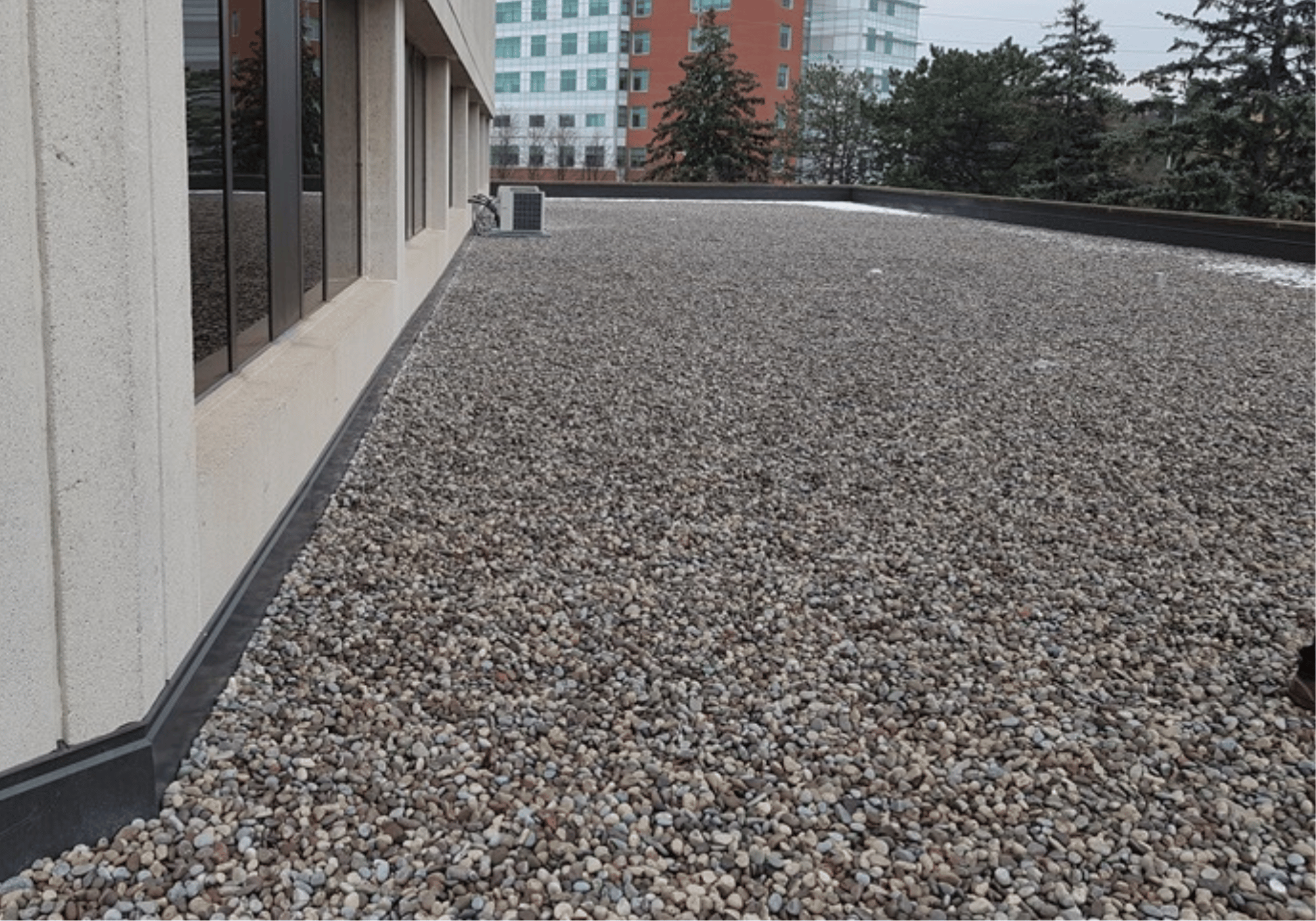
Omaha's older commercial inventory — Downtown, Midtown, and the pre-1980 industrial stock along the Missouri River corridor — carries a significant BUR inventory. We inspect, repair, recover, and replace built-up roofing systems and give owners an honest account of what the system actually needs.
Built-up roofing (BUR) is the original multi-ply commercial roof system — alternating layers of bitumen and reinforcing felts, surfaced with gravel or a smooth cap sheet, installed over a rigid substrate. At its best, BUR is an extremely durable system: the mass of the multi-ply assembly handles freeze-thaw cycling well, the gravel ballast provides UV protection and some hail resistance, and well-maintained BUR systems on Downtown Omaha buildings installed in the 1960s and 1970s are still watertight 50 years later. At its worst, BUR is a maintenance nightmare: delaminated plies, failed flashing at parapets and penetrations, alligatored surface, ponding that accelerates bitumen degradation.
We are honest about what BUR systems actually need. If the plies are intact, the insulation is dry, and the surfacing is repairable, targeted repair and surface maintenance is the right call. If the plies are delaminating across large sections, the insulation is saturated, and the flashings are failing at multiple locations, the honest scope is replacement. We do not sell comprehensive BUR restoration on roofs that need replacement, because the owner ends up paying twice.
Our BUR assessment starts with a roof walk documenting visible conditions: alligatoring, ridging, blistering, ponding locations, flashing condition at parapets and penetrations, drain function. On roofs where we suspect insulation saturation, we pull moisture cores. On roofs with structural concerns or suspected deck deterioration, we pull inspection ports at suspect locations. The written condition report gives the owner enough information to make a capital decision — not a sales pitch for the most expensive scope.
Reading a BUR Roof's Condition
Alligatoring: Surface bitumen has oxidized and cracked into a pattern resembling alligator skin. Common on smooth-surfaced BUR that has lost its reflective coating. Alligatoring alone does not mean the plies below are failing — but it does mean UV is now reaching the reinforcing plies at every crack, accelerating ply degradation. Alligatored BUR gets a flood coat and new gravel or a fluid-applied coating to stop UV penetration, if the plies below are still intact.
Ridging: The felts have absorbed moisture and expanded, pushing ridges up through the surface. Ridging across large areas indicates systemic moisture infiltration in the ply assembly — moisture core pulls are needed to establish how deep the saturation runs. Surface ridging on an otherwise intact system can be cut, dried, and patched. Ridging across more than 20% of the roof area typically indicates a system-level problem requiring recover or replacement.
Blistering: Trapped moisture or volatile compounds in the bitumen have formed gas pockets under the surface ply. Blisters that are not breached can be cut, dried, and back-mopped if the surrounding plies are intact. Widespread blistering indicates installation defects or systemic moisture intrusion. Open blisters that have allowed water infiltration require ply repair plus surface treatment.
Flashing failure at parapets and penetrations: BUR flashing is typically stripping plies — layers of bitumen-saturated felt mopped out from the field membrane up the parapet or penetration. Nebraska's freeze-thaw cycling works these stripping plies hard. The brick parapets common on Downtown Omaha buildings move significantly with temperature — the stripping plies crack and pull away from the parapet face, and water enters at every crack. BUR flashing repair at parapets is the highest-ROI maintenance spend on most Omaha BUR systems.
BUR Recover with Modified Bitumen Cap Sheet
The most common BUR renovation scope on Omaha's aging commercial stock is a modified bitumen cap sheet recover over the existing BUR. The existing gravel is broadcast-embedded in a flood coat of cold-applied bitumen adhesive, creating a bondable surface. A modified bitumen cap sheet (SBS or APP formulation) is then torched or cold-applied over the existing BUR surface, extending the assembly's life another 15-20 years without a full tear-off.
This works when the existing BUR's insulation is dry (verified by moisture cores), the deck is sound, and the plies are intact. When it fails is when contractors skip the core pulls, recover over wet insulation, and the new cap sheet then traps that moisture — voiding any warranty and accelerating the underlying system's deterioration. We pull cores on every BUR recover project. If insulation is wet, the wet sections are removed and replaced with new insulation before the cap sheet goes down.
Modified bitumen SBS (styrene-butadiene-styrene) is the standard cap sheet for Omaha — the elastomeric modifier makes it flexible at the sub-zero temperatures Nebraska winters produce. APP (atactic polypropylene) formulations are stiffer at low temperatures and are less suited to Nebraska's cold envelope. We specify SBS on all BUR recover work in this climate.
Full BUR Replacement — When Recovery Is Not the Right Call
When moisture cores show saturation across more than 25% of the roof area, when the deck shows deterioration under wet insulation sections, or when the ply assembly is delaminating at scale, full tear-off and replacement is the honest scope. On BUR systems, tear-off means removing all plies, the interply bitumen, the insulation, and (where necessary) the deck. This is debris-intensive work — a 5-ply built-up roof with gravel surfacing generates significant waste weight. We stage dumpsters for BUR tear-off projects and calculate the structural implications of debris weight before staging to confirm the building structure can handle it.
New construction on former BUR buildings typically goes to mechanically attached TPO with polyiso insulation — lighter, faster to install, and warrantied for 20 years. Some owners prefer to remain on BUR for occupancy or acoustic reasons (BUR's mass provides better sound attenuation than single-ply on commercial buildings adjacent to rail or freight corridors). When the owner wants to stay on BUR, we install a modern 4-ply BUR system with base sheet, two intermediate felts, and a modified bitumen cap sheet — the highest-performing BUR specification for the Nebraska climate.
Frequently asked questions
My BUR roof is 30 years old. Should I recover or replace it?
Age alone does not determine the answer — insulation condition and ply integrity do. A 30-year BUR with dry insulation and intact plies is a strong candidate for modified bitumen cap sheet recover. A 30-year BUR with saturated insulation across large areas needs replacement. We pull moisture cores to give you the actual answer, not the one that sells the most work.
How long does BUR repair typically take on a Downtown Omaha building?
Targeted BUR repair — flashing replacement at parapets and penetrations, blister repair, crack routing and fill — typically runs 2-5 days for a 20,000-30,000 sq ft roof. Full recover with modified bitumen cap sheet runs 1-2 weeks for the same footprint. Access and permitting on Downtown Omaha buildings (crane, lane closure, parking permit) can add pre-mobilization time of 2-3 weeks.
Can you repair a BUR roof in Omaha winter?
Hot-mopped BUR and torch-applied modified bitumen require substrate temperatures above 40°F for proper adhesion. Cold-applied bituminous repair products can be applied at lower temperatures. Emergency temporary repairs — stopping an active leak — can be done with cold-applied materials in any weather. Permanent BUR repair and recover is scheduled for April through October in most years.
BUR inspection or scope for your Omaha building?
We will walk the roof, pull cores where the condition warrants it, and deliver a written condition report with a repair, recover, or replace recommendation — and the reasoning behind it.
Ready to talk through a roof?
Tell us about the building and the roof problem. We'll document it and put a plan in writing — with an honest repair-vs-replace recommendation and no upsell pressure.