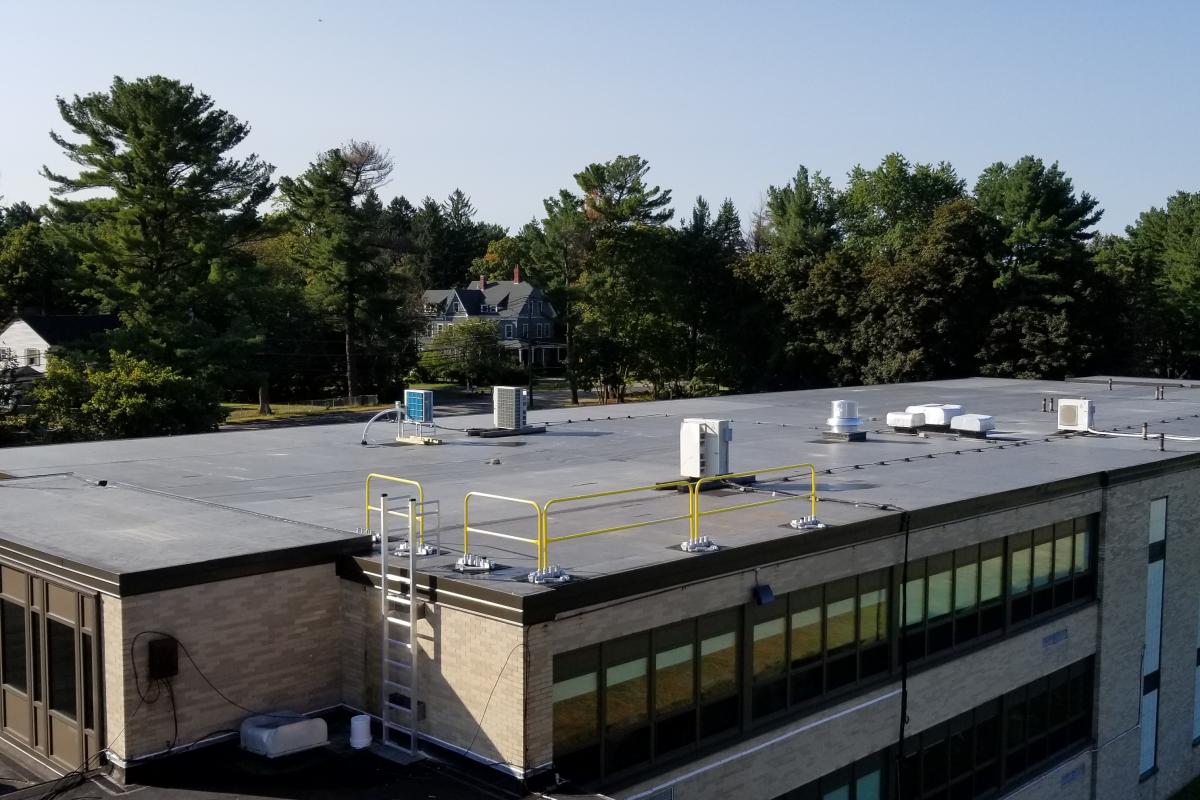
Omaha's older commercial inventory — Downtown, Midtown, and the pre-1980 industrial stock along the Missouri River corridor — carries a significant BUR inventory. We inspect, repair, recover, and replace built-up roofing systems and give owners an honest account of what the system actually needs.
The City of Omaha's Purchasing Division administers competitive procurement for public facility roofing under Nebraska's statutes governing public contracts. Contracts above the formal threshold require sealed competitive bids, advertised in the Daily Record and posted on the city's procurement website. Nebraska does not operate a centralized statewide procurement portal, so contractors tracking Omaha city work monitor the city's site directly, while Douglas County procurement is managed through a separate county process. Nebraska requires that contractors bidding public works projects above $100,000 be registered with the Nebraska Department of Labor, a requirement that applies both to the general contractor and to roofing subcontractors on covered projects.
Nebraska enacted a prevailing wage law that applies to public construction projects, and the Nebraska Department of Labor sets wage schedules by trade classification and county. Douglas County's prevailing wage rates for roofing trades reflect the Omaha metropolitan labor market and are updated periodically. Contractors must pay prevailing wages, post wage schedules at the job site, and maintain payroll records available for inspection. When federal funding is also present on an Omaha project, Davis-Bacon rates apply, and contractors must use the higher of the Nebraska or federal rate for each classification. Nebraska's prevailing wage compliance is monitored by the DOL, and the state has pursued enforcement actions against contractors who have allowed wage violations to accumulate on public projects.
Hail damage drives a significant share of Omaha's municipal roofing replacement activity. Douglas County and the City of Omaha have both experienced multi-million dollar losses on public facilities from hail events, and the procurement response to storm damage often involves expedited purchasing authority that allows agencies to bypass normal competitive bidding timelines in genuine emergency situations. Contractors who maintain relationships with city and county facility managers, carry adequate insurance and bonding, and can mobilize quickly after a storm event have historically been well-positioned for these post-storm recovery contracts. Specification writers have responded to the frequency of hail damage by requiring impact-resistant roofing products with documented Class 4 ratings on new and replacement systems for critical public facilities.
Energy performance standards for Omaha's public facilities reflect Nebraska's cold climate and the city's participation in the Nebraska Energy Office's programs for local governments. The dominant energy roofing strategy in Omaha is thermal: continuous insulation above the deck, airtight assembly details at penetrations and curbs, and vapor retarder systems positioned correctly for the climate zone. Nebraska falls in ASHRAE climate zone 6, which requires substantial insulation R-values for low-slope roofing on public buildings. The Nebraska Energy Office has provided technical assistance and some grant funding to municipalities for energy-efficient building upgrades, and roofing projects that incorporate insulation improvements beyond code minimums may qualify for program support. Cool-roof requirements matter during Omaha's hot summers but are secondary to thermal performance given the heating-dominated annual energy balance.
The Omaha Public Library's downtown branch at is a significant civic anchor, and several branch library facilities occupy historic or architecturally notable buildings. Historic preservation considerations apply to the Gene Leahy Mall civic campus area, where older public buildings carry potential National Register eligibility. Projects on these buildings that involve federal funding require Section 106 consultation with the Nebraska State Historical Society's historic preservation office. The SHPO review focuses on the compatibility of proposed roofing materials and methods with the building's historic character. Nebraska's SHPO is generally engaged and constructive in preconstruction consultation, and early outreach before bid documents are finalized reduces the risk of required design changes during construction.
Bonding requirements for Omaha public roofing contracts are established under Nebraska statute. The Nebraska Little Miller Act requires performance and payment bonds on public construction contracts above $50,000. Both bonds must be at 100 percent of the contract value. Bid bonds of ten percent of the bid amount are typically required on City of Omaha solicitations. Sureties must be admitted to do business in Nebraska, and contractors should verify their surety's Nebraska authorization status before pursuing public work in the state. Douglas County applies the same statutory bonding requirements through its own procurement process, and contractors who work across both the city and county portfolios should maintain bonding capacity adequate for concurrent project obligations.
Omaha Fire Division stations range from historic neighborhood firehouses in the Dundee and Benson neighborhoods to modern facilities in the city's south and west growth areas. The older stations often have slate or clay tile roofing on pitched sections above apparatus bays, requiring specialized preservation and replacement approaches, while the flat-roof sections of these same buildings may have built-up or modified bitumen systems dating from mid-century renovations. Project scopes on these mixed-system buildings require contractors with expertise across both steep and low-slope roofing disciplines. Douglas County's capital projects office coordinates with the city on shared facilities and joint-use buildings, and some roofing projects touch property under the jurisdiction of more than one public entity.
Long-term contractor performance on Omaha public facility projects is tracked through the city and county's vendor performance evaluation systems. City of Omaha procurement staff record contractor performance ratings on completed projects, and these records are consulted when evaluating subsequent bids from the same firm. Contractors who consistently deliver quality work, maintain compliance with prevailing wage and insurance requirements, and close out projects cleanly with complete documentation accumulate favorable performance histories that provide meaningful advantages in future procurement evaluations. Building a sustained record of successful public work in Omaha takes years, but it creates a durable competitive position in a market where public facility roofing activity is consistent year over year.
- Does Nebraska have a prevailing wage law that applies to Omaha public roofing contracts?
- Yes. Nebraska's prevailing wage law applies to public construction contracts, and the Nebraska Department of Labor sets wage schedules by trade and county. Douglas County's roofing trade rates reflect the Omaha labor market and are updated periodically. When federal funding is also present, Davis-Bacon requirements apply, and the higher of the two rate sets governs for each trade classification.
- What Nebraska contractor registration is required for Omaha public roofing projects?
- Contractors bidding Nebraska public works projects above $100,000 must be registered with the Nebraska Department of Labor. This registration requirement applies to the general contractor and to roofing subcontractors on covered projects. Registration must be current before work begins, and contractors should verify their registration status and expiration date before pursuing solicitations.
- Are impact-resistant roofing systems specified on Omaha public buildings?
- Yes. Given Omaha's position in one of the country's most active hail corridors, specifications for critical public facilities increasingly require roofing systems with UL 2218 Class 4 or FM 4473 Class 4 impact resistance ratings. These requirements have become more common following significant hail losses on City of Omaha and Douglas County facilities. Contractors should verify that proposed systems carry the required ratings and document compliance in submittals.
- What bonding does Nebraska's Little Miller Act require for Omaha public roofing contracts?
- Nebraska's Little Miller Act requires performance and payment bonds each at 100 percent of the contract value for public construction contracts above $50,000. Bid bonds of ten percent are typical on City of Omaha solicitations. All bonds must be issued by sureties admitted to do business in Nebraska. Douglas County applies the same statutory requirements through its own procurement process.
- How does Omaha's climate zone affect insulation requirements for public building roofs?
- Omaha is in ASHRAE climate zone 6, which requires substantial continuous insulation R-values for low-slope roofing under current energy codes. Specifications for publicly funded facilities often exceed code minimums to reduce long-term heating costs. Vapor retarder positioning is critical in this cold climate zone, and incorrect vapor retarder placement can cause interstitial condensation that degrades insulation performance and damages roof structure over time.
Frequently asked questions
My BUR roof is 30 years old. Should I recover or replace it?
Age alone does not determine the answer — insulation condition and ply integrity do. A 30-year BUR with dry insulation and intact plies is a strong candidate for modified bitumen cap sheet recover. A 30-year BUR with saturated insulation across large areas needs replacement. We pull moisture cores to give you the actual answer, not the one that sells the most work.
How long does BUR repair typically take on a Downtown Omaha building?
Targeted BUR repair — flashing replacement at parapets and penetrations, blister repair, crack routing and fill — typically runs 2-5 days for a 20,000-30,000 sq ft roof. Full recover with modified bitumen cap sheet runs 1-2 weeks for the same footprint. Access and permitting on Downtown Omaha buildings (crane, lane closure, parking permit) can add pre-mobilization time of 2-3 weeks.
Can you repair a BUR roof in Omaha winter?
Hot-mopped BUR and torch-applied modified bitumen require substrate temperatures above 40°F for proper adhesion. Cold-applied bituminous repair products can be applied at lower temperatures. Emergency temporary repairs — stopping an active leak — can be done with cold-applied materials in any weather. Permanent BUR repair and recover is scheduled for April through October in most years.
BUR inspection or scope for your Omaha building?
We will walk the roof, pull cores where the condition warrants it, and deliver a written condition report with a repair, recover, or replace recommendation — and the reasoning behind it.
Ready to talk through a roof?
Tell us about the building and the roof problem. We'll document it and put a plan in writing — with an honest repair-vs-replace recommendation and no upsell pressure.