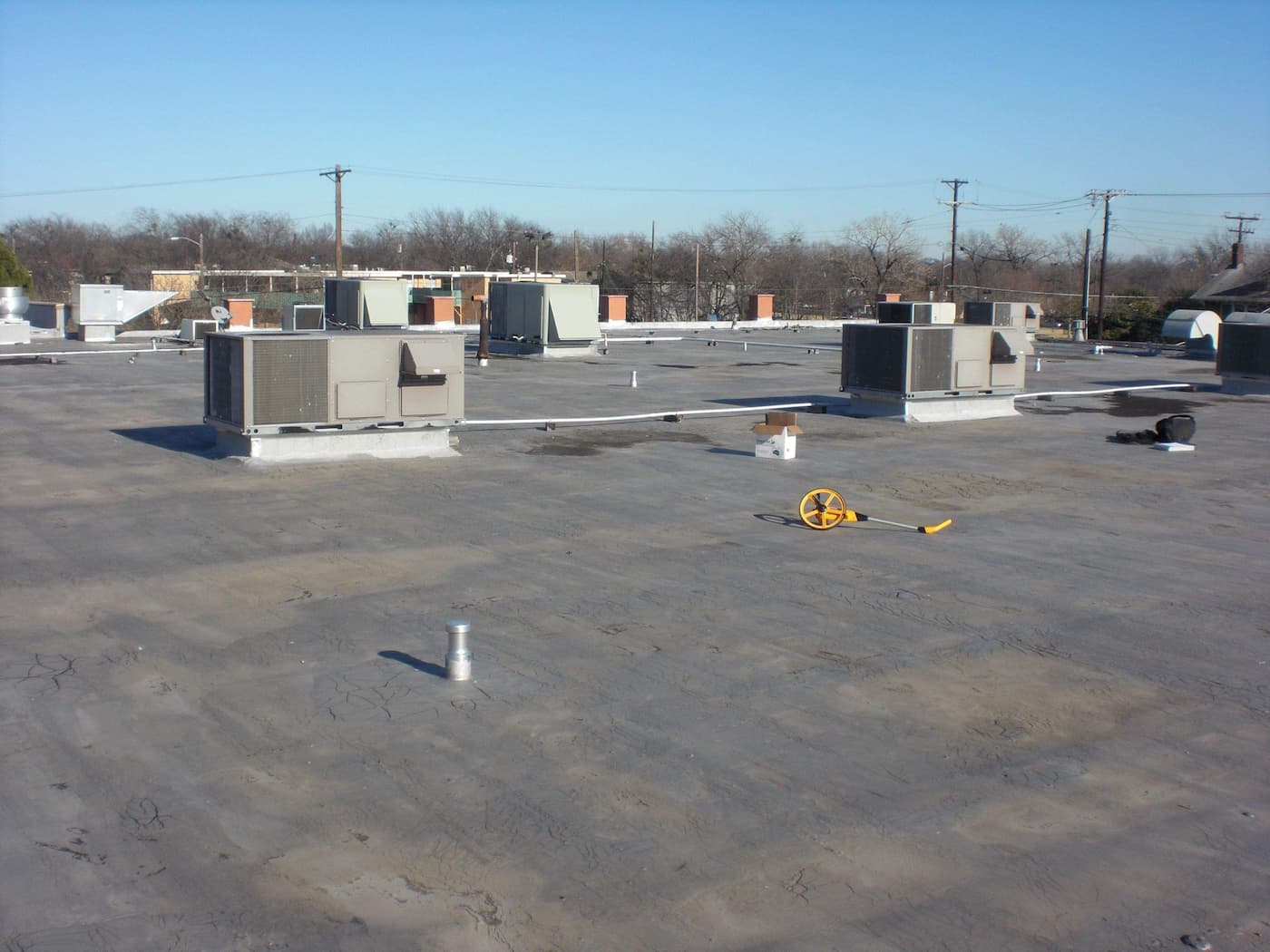
Douglas County sees hail events in the 1.5-to-2.5-inch range most springs. We document the damage to insurance-grade standards before any repair work begins, produce a written scope that distinguishes pre-existing condition from storm-related damage, and complete the repair with manufacturer-compatible materials.
Hail damage on a commercial flat roof is not always obvious from the ground. A 1.75-inch stone that puts a divot in a 45-mil TPO membrane may not break through — but it fractures the membrane's internal reinforcement scrim, and that latent fracture becomes an active puncture within two or three freeze-thaw cycles. A 2.5-inch stone on an aging modified bitumen granule surface removes the granules that protect the bitumen from UV and creates a bare-bitumen exposure zone that cracks within a season.
The documentation step matters as much as the repair. An insurance adjuster needs to distinguish hail damage from pre-existing wear — and without a written inspection report with date-stamped photographs taken before any work begins, that distinction becomes a dispute. We conduct every post-hail inspection in a sequence: inspection and documentation first, report delivered, scope agreed with the building owner and adjuster, then repair. We do not start repair before the inspection is documented.
Our project managers are familiar with the hail patterns that affect the Omaha metro. Spring hail tracks tend to move out of the southwest through Douglas County toward Council Bluffs and the Iowa border — the industrial buildings near Eppley Airfield, the commercial corridors along the Dodge Street spine, and the South Omaha industrial district are all in the typical hail corridor. We can be on a roof the morning after a significant hail event for commercial buildings on our maintenance program.
How We Document Hail Damage
The inspection starts with a roof zone diagram — we divide the roof into labeled zones and photograph each zone systematically before documenting any individual damage location. Every impact location is photographed with a reference marker showing stone size estimate and located on the zone diagram. Granule loss on modified bitumen is documented by zone and estimated coverage percentage. Membrane depressions or punctures on single-ply systems get close-up photography and a probe test to determine membrane integrity.
We photograph the metal components — counterflashing, parapet coping, HVAC curbs, vents, and gutters. Denting and bruising on soft metal surfaces is one of the clearest indicators of hail diameter and storm energy, and adjusters use the metal damage pattern to calibrate the membrane damage assessment. The documentation includes GPS-tagged timestamp metadata on every photograph.
The report includes a written narrative distinguishing storm-related damage from pre-existing conditions. On an Omaha building with an aging 45-mil TPO membrane that was already showing UV degradation and seam distress before the storm, we note what was storm-related and what was already in deteriorating condition. This distinction protects the building owner in a coverage dispute — and it protects us from completing repair work that will be blamed on the storm when the next failure appears.
What the Repair Covers
Puncture repair on single-ply membranes: TPO and EPDM punctures are repaired with manufacturer-compatible patch material heat-welded (TPO) or bonded with EPDM-compatible seam tape and adhesive (EPDM). Patch dimensions are sized per manufacturer specifications — typically a minimum 6-inch margin around the impact zone. On 45-mil systems with significant impact, we may recommend full replacement of the affected zone rather than patching over compromised base material.
Modified bitumen granule loss: Bare-bitumen exposure zones get a granule-surface restoration using a manufacturer-compatible mineral-surface cap sheet patch or a compatible coating system applied to the affected zone. Extensive granule loss across large field areas may indicate that recovering or replacing the affected sections is more cost-effective than spot patching.
Metal component restoration: Dented counterflashing that has opened gaps at terminations gets reformed or replaced. Coping caps that have separated from their clips get re-secured and re-sealed. Damaged vents or exhaust housings are replaced. Metal gutter and downspout damage is scoped separately from the roof membrane but included in the inspection report.
Flashing and termination repair at hail-displaced joints: Large hail events sometimes dislodge caulk and sealant at termination joints — the impact vibration works the sealant loose in joints that were already aging. We re-tool all open terminations identified in the inspection, using manufacturer-compatible sealant rated for the membrane system.
Working with Adjusters on Omaha Hail Claims
We do not act as public adjusters and we do not represent insureds in coverage negotiations. What we provide is the documentation an adjuster needs to establish scope and price the repair: a photo-keyed condition report, a repair scope with line-item quantities and materials, and a written assessment of storm-related versus pre-existing damage.
Hail claims on Omaha commercial flat roofs often turn on the question of membrane type and age. A 45-mil TPO system that is 15 years old and already showing seam distress gets treated differently than a three-year-old 60-mil system. We include membrane age, installation record (where available from building files), and current condition in the report — the context that lets an adjuster price the claim accurately rather than defaulting to a blanket allowance that either over-pays or under-funds the actual repair.
Frequently asked questions
How quickly can you inspect a building after a hail event in Omaha?
For buildings on our maintenance program, we prioritize post-storm inspection the following business day or within 24 hours if the event was severe. For new clients, we typically schedule inspections within three to five business days of a significant hail event — peak demand after a storm that affects Douglas County can stretch scheduling, but we give priority to documentation-urgent situations where an insurance claim is pending.
Do you do the inspection and the repair, or just one?
We do both. The inspection comes first, report is delivered, and repair is scoped from the inspection findings. We do not start repair work before the inspection documentation is complete — the documentation sequence is what protects the building owner in a coverage dispute.
What membrane types are most vulnerable to Omaha hail events?
Older 45-mil TPO is the most vulnerable single-ply system — the thinner membrane deforms under impact more readily than modern 60-mil or 80-mil systems, and the deformation fractures the internal reinforcement scrim without necessarily puncturing the surface immediately. Modified bitumen granule-surface cap sheets are vulnerable to granule loss, which accelerates UV degradation. EPDM 45-mil shows impact bruising but tends to deform elastically rather than fracturing — the failure mode is typically delayed, appearing at the bruise location after subsequent freeze-thaw cycling.
Need hail damage documentation and repair on an Omaha commercial roof?
We document before we repair — photo-keyed reports, written scopes, and adjuster-ready findings for every hail damage project across the Douglas County commercial inventory.
Ready to talk through a roof?
Tell us about the building and the roof problem. We'll document it and put a plan in writing — with an honest repair-vs-replace recommendation and no upsell pressure.