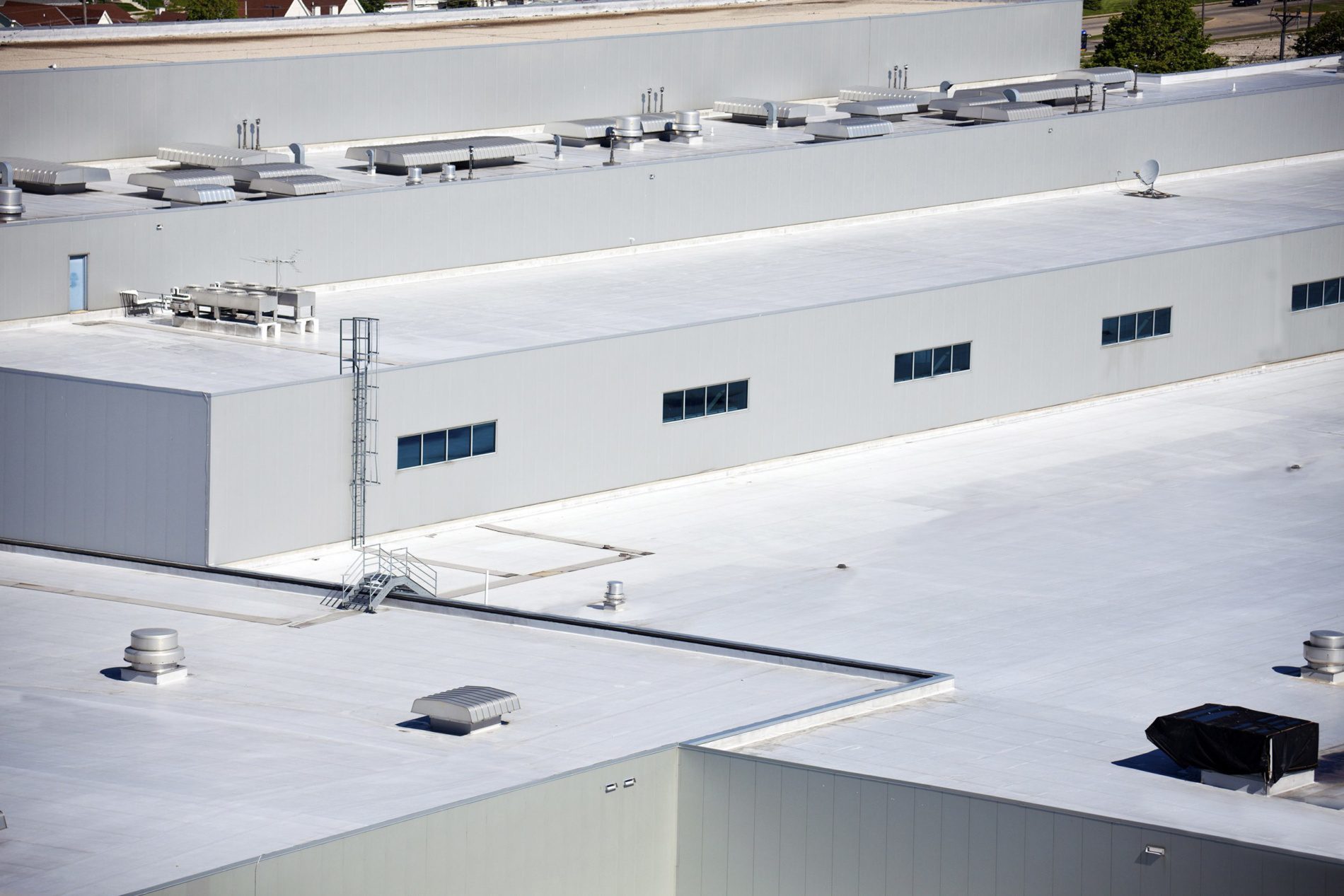
Omaha's older commercial inventory — Downtown, Midtown, and the pre-1980 industrial stock along the Missouri River corridor — carries a significant BUR inventory. We inspect, repair, recover, and replace built-up roofing systems and give owners an honest account of what the system actually needs.
Valmont Industries' manufacturing operations in Valley, Nebraska — just outside Omaha — and the broader agricultural and industrial manufacturing sector that defines the Omaha-Council Bluffs metropolitan area anchor a commercial roofing market shaped by Great Plains climate extremes, agricultural chemical exposure, and the heavy manufacturing loads associated with irrigation equipment, steel structures, and food processing. Omaha's manufacturing corridor, which extends south along US-75 and west along I-80, includes food and beverage producers, metal fabricators, grain handling equipment manufacturers, and the distribution infrastructure that serves the nation's agricultural heartland.
Agricultural and food processing manufacturing dominates Omaha's industrial sector in ways that directly shape roofing requirements. ConAgra Foods' corporate and production presence in Omaha, combined with the meat processing operations at facilities like Greater Omaha Packing, creates food safety regulatory requirements that affect every aspect of facility maintenance including roofing. FDA and USDA inspections of food manufacturing facilities examine building maintenance records, and facilities with documented roofing deficiencies in production areas can face compliance actions that are far more costly than the roofing work that would have prevented them. Omaha contractors serving food manufacturers understand this regulatory context and design maintenance programs that maintain the documentation trail required for audit readiness.
Temperature extremes in the Omaha-Council Bluffs area span a range that tests roofing materials more severely than many national standards anticipate. January low temperatures below minus 20°F and August heat indices above 110°F create a thermal cycling range that approaches 140°F between seasonal extremes. Roofing membranes must maintain flexibility at low temperatures to avoid cold-crack failures during winter freeze events and must resist heat-induced blistering and seam softening during summer heat waves. Omaha contractors specify low-temperature-rated EPDM or cold-climate TPO formulations for manufacturing applications and require manufacturer documentation of performance testing at the temperature extremes the local climate actually produces.
Agricultural chemical exposure is a broadly relevant concern for manufacturing roofs in the Omaha area even at facilities that do not directly process agricultural chemicals. The concentration of grain handling, seed treatment, fertilizer distribution, and agricultural chemical formulation operations in the Omaha metro means that ambient air quality during spring planting and fall harvest seasons includes elevated concentrations of ammonia, herbicide compounds, and organic dust that settle on roof surfaces throughout the region. Roofing maintenance programs for Omaha manufacturing facilities should include surface cleaning after major agricultural activity peaks to remove these deposits before they can degrade coating performance.
The Missouri River flood plain context of the Omaha-Council Bluffs metro area creates drainage design requirements that go beyond normal flat roof performance expectations. Facilities in low-lying areas along the river have experienced flooding events that challenged building envelopes from below as well as from above during periods of extended high water. While the roof drainage system's primary function is managing precipitation, facilities in flood-adjacent areas should ensure that their roof drains discharge to systems that function correctly during both normal operation and high-water events, and that mechanical penthouse areas and rooftop equipment are designed to function even during brief periods of elevated exterior water levels.
Process equipment at Omaha food manufacturing facilities generates steam, high-pressure water vapor from cleaning operations, and exhaust from fryers, ovens, and cooking processes that creates some of the most corrosive rooftop environments in the industrial sector. Grease-laden air exhaust from food processing operations coats roof surfaces near exhaust stacks with a film that promotes biological growth, holds moisture, and eventually degrades coating performance. Contractors serving Omaha food manufacturers specify non-porous coatings at exhaust stack locations, schedule quarterly cleaning of affected roof areas, and recommend exhaust stack extension heights that direct discharge away from critical roof zones when building and regulatory conditions allow.
Heavy vibration from grain handling conveyors, large-scale food processing equipment, and metalworking machinery at Omaha's manufacturing facilities requires roofing system design that accounts for dynamic loading throughout the service life of the system. Bucket elevators and drag chain conveyors in grain facilities generate cyclical vibration that is transmitted through building frames with the same pattern and timing as a mechanical heartbeat. Roofing systems installed in these buildings without vibration isolation at equipment curbs and without fully-adhered membranes in high-vibration zones consistently develop fastener-fatigue failures within seven to ten years, well short of the warranty period.
Energy efficiency is a financially compelling driver for manufacturing roof insulation upgrades in Omaha, where both heating and cooling loads are substantial and where natural gas and electricity costs have risen significantly in recent years. Large manufacturing buildings with low insulation R-values — a common condition in the older building stock along the US-75 corridor — represent significant energy savings opportunities. MidAmerican Energy's commercial efficiency program and the Nebraska Power Review Board's incentive programs both offer rebates for qualifying commercial insulation improvements, and federal tax provisions including Section 179D provide additional financial incentives for energy improvements at manufacturing facilities.
Maintenance program discipline is particularly valuable for Omaha manufacturing roofs because the combination of severe climate, agricultural chemical exposure, biological growth, and food regulatory requirements creates multiple independent degradation pathways that a well-structured program can catch and address at early stages. Annual inspections supplemented by post-hail and post-severe-storm inspections, combined with quarterly drain clearing and semi-annual biological growth treatment, consistently extend membrane service life by four to seven years compared to reactive-only maintenance approaches. The return on investment for a disciplined maintenance program at a large Omaha manufacturing facility is typically four to six dollars of replacement cost avoidance for every dollar invested in preventive maintenance.
- What food safety documentation should Omaha food manufacturers maintain for roofing work?
- Food manufacturing facilities should maintain a roofing project file that includes contractor qualifications, material safety data sheets for all materials used in or near the facility, installation inspection reports, warranty documentation, and a record of any incidents where work activities potentially affected interior air quality or contamination risk. This file should be incorporated into the facility's standard maintenance documentation system and be available on demand for USDA or FDA audits. Contractor selection should include verification that the roofing firm is familiar with food manufacturing contamination control requirements.
- How should Omaha manufacturing facilities manage roofing through the Missouri River flood plain risks?
- Facilities in FEMA-designated flood zones should ensure that rooftop mechanical equipment critical to facility operations is elevated above the base flood elevation and that all penetrations through roof-level walls are designed to prevent backflow during flood events. Roof drainage systems should be evaluated for performance during periods when the municipal storm sewer system is at capacity, and emergency overflow provisions should be confirmed to be functional and unobstructed before spring flood season each year.
- What temperature ratings should be specified for manufacturing roofing membranes in the Omaha climate?
- Roofing membranes for Omaha manufacturing applications should be rated for flexibility down to minus 25°F to ensure performance during Nebraska's coldest events without cold-crack failures. EPDM membranes from major manufacturers are generally rated to this temperature or below, but the specific product specification should be confirmed in writing. TPO products vary in their cold-temperature performance, and the cold flexibility specification should be confirmed in the product's published technical data sheet before inclusion in a project specification.
- What hail damage risks should Omaha manufacturing facility managers anticipate?
- The Omaha area receives moderately severe hail on a regular basis, with events producing hail above one inch in diameter occurring several times per year on average. Roofing systems should be specified with hail resistance in mind, and a post-hail inspection protocol should be established that triggers an inspection within 24 to 48 hours of any event that produces reportable hail in the facility's zip code. Prompt identification and temporary patching of hail damage prevents secondary water intrusion that can be substantially more expensive than the initial impact damage.
- What are the most important considerations when re-roofing a grain handling or agricultural equipment facility near Omaha?
- The most critical considerations are material compatibility with ammonia and organic dust exposure common in agricultural environments, structural assessment of existing decking for load capacity before adding new insulation, and vibration evaluation in areas near conveyors or heavy processing equipment. Scheduling the project during late summer or fall, after harvest begins but before the heaviest grain elevator operation season, typically provides the best combination of weather conditions and facility access. A thorough pre-project investigation that includes core sampling and pull-out tests provides the data needed to specify an appropriate system and budget accurately.
Frequently asked questions
My BUR roof is 30 years old. Should I recover or replace it?
Age alone does not determine the answer — insulation condition and ply integrity do. A 30-year BUR with dry insulation and intact plies is a strong candidate for modified bitumen cap sheet recover. A 30-year BUR with saturated insulation across large areas needs replacement. We pull moisture cores to give you the actual answer, not the one that sells the most work.
How long does BUR repair typically take on a Downtown Omaha building?
Targeted BUR repair — flashing replacement at parapets and penetrations, blister repair, crack routing and fill — typically runs 2-5 days for a 20,000-30,000 sq ft roof. Full recover with modified bitumen cap sheet runs 1-2 weeks for the same footprint. Access and permitting on Downtown Omaha buildings (crane, lane closure, parking permit) can add pre-mobilization time of 2-3 weeks.
Can you repair a BUR roof in Omaha winter?
Hot-mopped BUR and torch-applied modified bitumen require substrate temperatures above 40°F for proper adhesion. Cold-applied bituminous repair products can be applied at lower temperatures. Emergency temporary repairs — stopping an active leak — can be done with cold-applied materials in any weather. Permanent BUR repair and recover is scheduled for April through October in most years.
BUR inspection or scope for your Omaha building?
We will walk the roof, pull cores where the condition warrants it, and deliver a written condition report with a repair, recover, or replace recommendation — and the reasoning behind it.
Ready to talk through a roof?
Tell us about the building and the roof problem. We'll document it and put a plan in writing — with an honest repair-vs-replace recommendation and no upsell pressure.