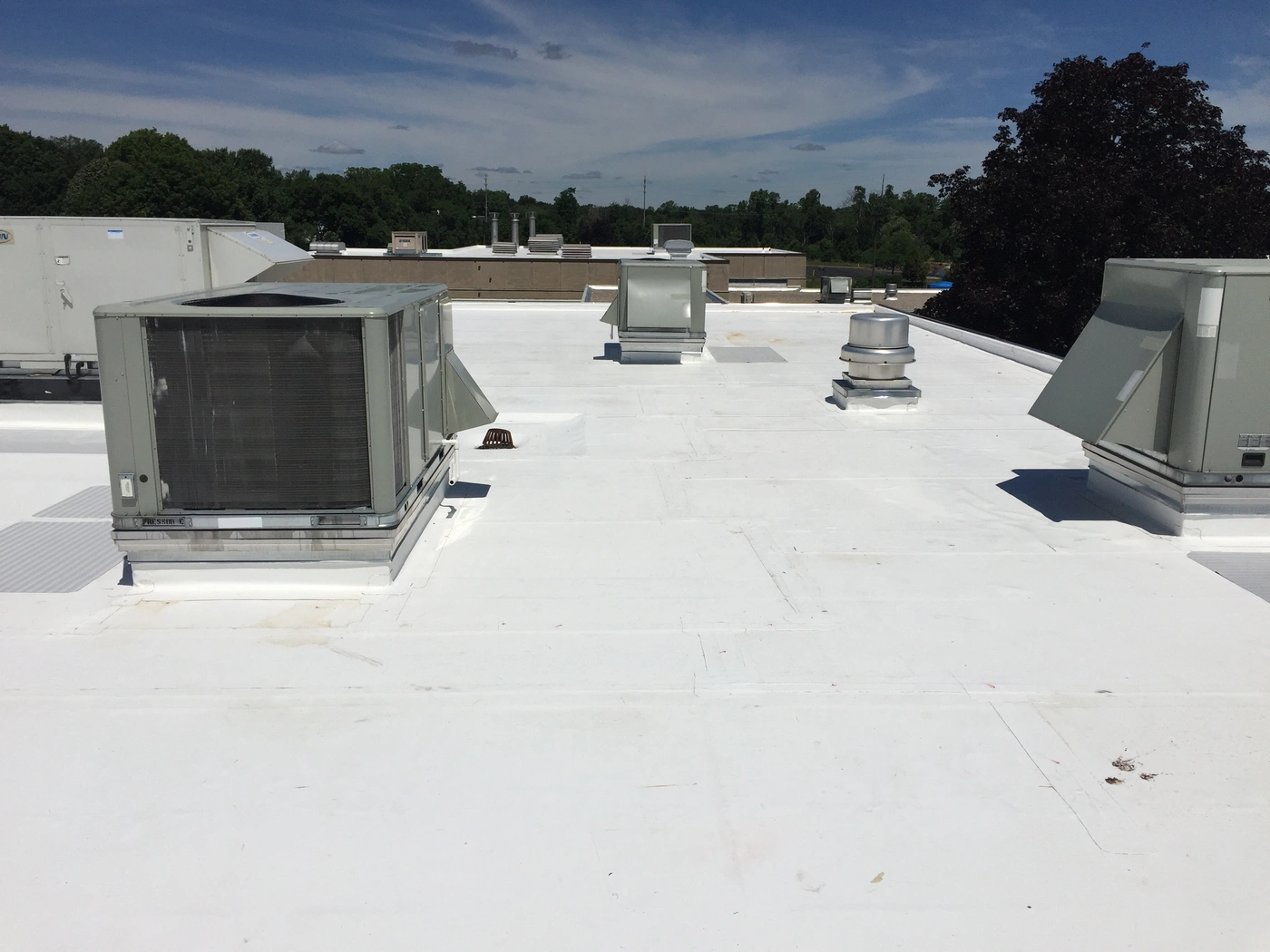
PVC (polyvinyl chloride) is the specified commercial roofing membrane for Omaha restaurants, food-production facilities, and any building where grease exhaust, chemical vapors, or solvents are present on or near the roof surface. Standard TPO and EPDM membranes degrade under grease and chemical exposure — PVC does not.
PVC roofing is a niche specification in the Omaha commercial market, but it is the correct specification for a specific class of buildings where standard membranes fail prematurely. Restaurants with rooftop exhaust systems — and the Omaha metro has hundreds of commercial kitchen exhaust penetrations on flat roofs from the Old Market to the West Dodge Road retail corridor — are the primary application. Grease-laden exhaust vapor condenses on the membrane surface around exhaust fans and penetrations, and it degrades TPO and EPDM membranes at an accelerated rate. PVC is formulated to resist grease and a broad range of chemicals — it is used in chemical plants, pharmaceutical facilities, and food processing operations for exactly this reason.
The ConAgra campus buildings on the Omaha riverfront — grain processing and food production facilities with complex rooftop exhaust systems — represent the type of building where PVC is the engineering-correct membrane choice. The food processing and distribution facilities in the North Omaha industrial zone and along the I-80 corridor are the same story. We have replaced prematurely degraded TPO on restaurant buildings along the West Dodge Road corridor with PVC after the TPO failed within five to eight years due to grease exhaust exposure — a failure mode that PVC's formulation prevents.
PVC is heat-welded the same way as TPO — hot-air welder with a test wheel on every seam. Seam quality standards are the same as TPO. PVC carries 20-year manufacturer warranties standard, and some systems carry 25-year warranties. Installed cost is higher than TPO on a per-square basis, but the relevant comparison is total lifecycle cost over the building's operating period — not the first-install cost alone.
PVC in the Omaha Restaurant and Food-Service Market
The Old Market in Downtown Omaha is one of the densest concentrations of restaurant rooftop exhaust in the metro — a historic warehouse district with dozens of restaurants operating in multi-story loft buildings where the flat roofs above the kitchens take concentrated grease exhaust discharge. The roofs on these buildings are often the original early-generation single-ply or modified bitumen systems, now running past their design life and showing accelerated grease-related degradation around exhaust penetrations.
The Aksarben Village retail and restaurant district, the West Dodge Road restaurant corridor from 72nd to 132nd Street, and the newer mixed-use developments in the Midtown Crossing area all run dense restaurant concentrations on flat-roofed commercial buildings. For multi-tenant retail strips where one or two restaurant bays expose the full roof to grease exhaust, PVC on the full field membrane is the protective specification — it prevents the grease from degrading the membrane in the zones away from the penetrations, not just at the point of exhaust.
We specify PVC with a welded pitch pocket at every grease exhaust penetration — a fully welded pocket detail filled with an appropriate sealant, rather than the standard pipe boot used on non-exhaust penetrations. This detail prevents grease from migrating under the membrane at the penetration point, which is the highest-failure-rate location on any restaurant roof.
PVC Performance in Nebraska's Thermal Cycle
PVC formulations vary by manufacturer in their cold-temperature performance. The original PVC membranes from the 1990s were prone to embrittlement at sustained sub-zero temperatures — a real limitation in the Omaha climate where January lows historically reach -25°F. Modern PVC formulations from Sika Sarnafil, Johns Manville, and Carlisle include plasticizers that maintain low-temperature flexibility comparable to EPDM across the Nebraska temperature range. We specify current-generation PVC formulations for all new installation — older formulations are not appropriate for the Omaha climate.
PVC's heat-weld seam system is identical to TPO's — this is a specification advantage over EPDM's adhesive seam in climates with the temperature cycling of eastern Nebraska. Heat-welded seams on PVC systems are mechanically stronger than adhesive-spliced seams and are not affected by adhesive cold-temperature limitations. We weld PVC seams with the same hot-air welder protocol and seam-probe test standard as TPO.
PVC in Chemical and Industrial Environments
Beyond restaurants, PVC is the right membrane for any Omaha commercial building where chemical exposure is a roofing concern. The industrial buildings in the North Omaha zone and along the Missouri River bottom — manufacturing, chemical processing, and materials handling facilities — sometimes have rooftop chemical storage or process equipment where vapor exposure is a design consideration. PVC's chemical resistance profile covers a wide range of common industrial solvents and process chemicals; EPDM's does not.
We review the chemical exposure profile with the building's facility manager before specifying PVC or any other membrane system. The relevant question is not just whether chemicals are present, but whether the rooftop exposure is to vapors or direct contact, what concentrations are typical, and whether the drainage from the roof contacts any chemical residue. This is a more detailed specification conversation than a standard commercial roofing project, and it requires a contractor who has done it before.
Frequently asked questions
Can PVC be installed over an existing TPO or EPDM membrane?
PVC is generally not directly compatible with EPDM in a recover configuration — the two membranes cannot be heat-welded together and must be separated by a cover board. PVC can be installed over a cover board on top of an existing EPDM or TPO system if the substrate is dry and the structural load allows. We design the cover board and fastener system for the specific substrate.
Is PVC more expensive than TPO?
Yes — PVC carries a higher per-square installed cost than TPO for equivalent mil thickness and warranty term. The cost premium is warranted for buildings with grease exhaust or chemical exposure, where the alternative is replacing a degraded TPO membrane at years five to eight rather than running a PVC system to its 20-25 year design life. We provide lifecycle-cost comparison between PVC and TPO for any building where the choice is not clear-cut.
What manufacturers of PVC roofing do you install?
Sika Sarnafil, Johns Manville, Carlisle, and Versico PVC systems. Manufacturer selection depends on warranty terms available for your building type, the thickness range specified, and manufacturer regional technical support. We recommend based on the technical fit, not inventory.
Restaurant or food-service facility in Omaha with a roofing question?
We will assess whether your current membrane is appropriate for your exhaust environment and quote a PVC system if the grease-exposure profile warrants it.
Ready to talk through a roof?
Tell us about the building and the roof problem. We'll document it and put a plan in writing — with an honest repair-vs-replace recommendation and no upsell pressure.