Solar belongs on a roof that can carry it for 30 years
A rooftop array is one of the longest commitments a building owner can make to a roof. The modules are warranted for a quarter century or more, and once they are racked and wired, nobody wants to touch them. That is exactly why we get pulled into so many Omaha solar projects before the panels are ordered: a 26-year array sitting on a membrane with six good years left is a problem with a five- or six-figure price tag attached. When that roof fails, somebody has to power down the system, unbolt or unload every module, set the racking aside, tear off and rebuild the assembly, then reinstall all of it. We would rather sort the roof out first.
Across the metro, the buildings drawing the most interest in solar are the same ones with the real estate for it: the big-box distribution roofs out by the I- 50 interchanges in Sarpy County, the food-processing and cold-storage plants in the South Omaha industrial belt, and the newer flat-roofed office and flex buildings going up around Aksarben and the Sterling Ridge area. Those roofs have wide, open low-slope fields and serious daytime electrical demand, which is what makes the panels pencil out. None of that tells you whether the roof underneath is ready, and that is the part we own.
How the array is held down decides how it touches your roof
There are two attachment philosophies for a flat-roof array, and each one pushes the roofing conversation in a different direction. A ballasted system rests on the membrane on protective pads and is pinned down by concrete blocks. No fasteners pierce the roof, which owners love, but it stacks dead load onto the deck — commonly four to six pounds per square foot once you add modules, rails, and ballast together. On the older steel bar-joist decks common in South Omaha's mid-century plants, that load is not a given. We want a structural engineer to verify the framing before a single ballast block is delivered.
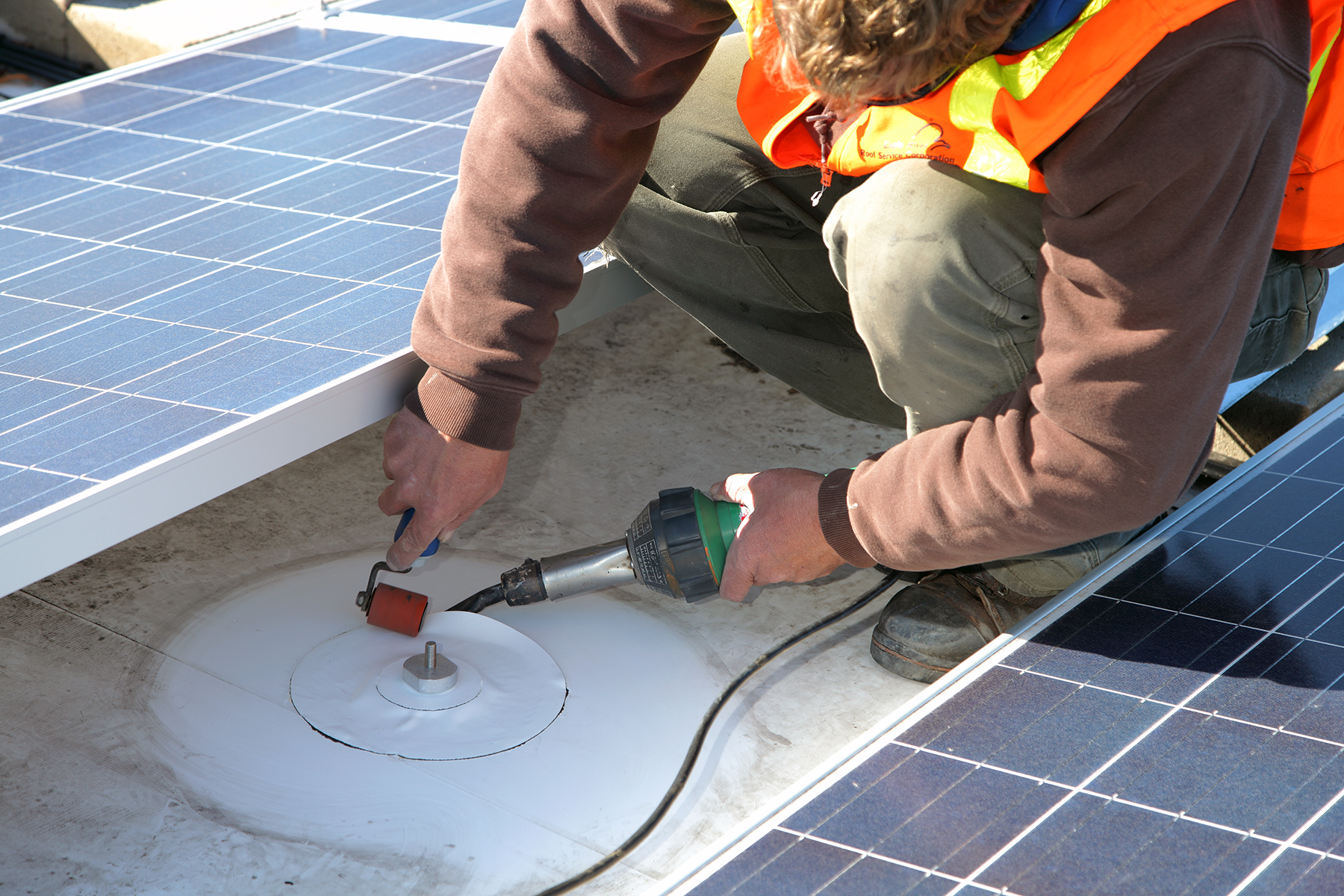
A mechanically attached system anchors the racking through the membrane and into the structure. It sheds weight and handles uplift far better, but now every foot is a roof penetration that has to be flashed to last and has to sit inside the membrane warranty. On a TPO or PVC roof, we insist each post tie into a manufacturer-sanctioned flashing boot rather than a pitch pan packed with caulk. Pitch pans shrink and split, and we have traced more than one young-array leak straight back to that exact shortcut.
Wind on the plains is a design input, not a footnote
Eastern Nebraska gets open-country wind, and the severe-storm season brings straight-line gusts and the occasional derecho rolling across the metro. A solar array is a sail if it has not been engineered for that exposure. Ballasted layouts are the most exposed, because steady wind sweeping an uninterrupted roof field can lift and creep an under-weighted array toward the downwind edge over time. The module layout, the ballast count in each roof zone, and the setback from the perimeter all come out of a wind calculation tied to this building's exposure category and parapet height — not a number the racking vendor carried over from a calmer part of the country.
That perimeter setback does double duty. Wind that catches the array near an unsecured edge can work the panels and the edge metal at the same moment. We would rather keep the array held back from the perimeter and confirm the edge metal is sound before any PV crew stages a pallet up there.
Some membranes host solar better than others
Not every roof surface wants an array bearing on it for decades. Reflective white TPO and PVC are our go-to substrates under PV in this market. The bright surface runs cooler, which the modules reward with better output, and both weld into continuous, monolithic seams that take the racking loads cleanly. Wherever rails or pads ride directly on the sheet, we add sacrificial slip sheets and walk pads so the constant micro-movement of the array does not abrade through the membrane. Aged EPDM and worn asphalt surfaces deserve a harder look, and sometimes a recover, before they are asked to carry an array.
Conduit routing is where roofing and solar trades collide most often. The DC and AC runs have to reach the inverters and the building's service, and the fast path for an electrician is to lay conduit flat on the membrane and punch through wherever it is handy. Flat conduit dams water and grinds the sheet; unplanned penetrations capped with a rubber boot are next year's leaks. We sit down with the PV installer before they pull a foot of pipe and settle on elevated supports, consolidated penetration points, and a proper through-roof detail at each one — flashed by our crew, not the electricians.
One warranty conversation with two contractors in the room
What goes wrong on a solar-plus-roof job is almost never the panels alone or the membrane alone. It is the handoff between them. The solar EPC assumes the roofer blessed the penetrations; the roofer assumes the solar crew followed the attachment spec; the membrane manufacturer never heard an array was going up, and now a routine warranty repair turns into a coverage fight. We shut that gap by putting everyone at the same pre-construction table.
Before anything is installed, we register the array with the membrane manufacturer, confirm the racking and attachment details appear on their approved list, document the protection layers and the conduit plan, and write down who flashes what. We sequence the job so the membrane is down and inspected before any racking lands, and so every penetration is flashed and watertight before conduit is pulled. When it wraps, you have one roof, one array, and a paper trail both warranties will honor.
We do not sell solar systems and we have no stake in whether you install one. Our job is to make sure the roof under that investment is sound, the attachments are detailed to last, and the warranty holds the day you need it. If you are weighing solar on an Omaha commercial building, bring us in to assess the roof before the array gets designed around it.
Common questions about solar roof integration
Should we reroof before the panels go on?
If the membrane has fifteen or more documented years left, the array can sit on the existing roof. If it is down to seven years or less, reroofing first almost always beats paying to remove and reinstall the array during a future tear-off. We give you a remaining-life estimate so the call rests on the actual roof, not a guess.
Will mounting solar put holes in our roof?
Not necessarily. Ballasted racking holds the array down with weighted blocks and no penetrations, provided your deck can carry the extra load. Penetrating racking is used where uplift or load limits rule out ballast, and there every anchor is flashed to a manufacturer-approved detail and kept under the membrane warranty.
Does adding an array void the roof warranty?
Only when it is done outside the manufacturer's rules. Major TPO and PVC manufacturers permit arrays on their warranted systems as long as the attachment details, protection layers, and pre-installation review meet their requirements. We run that review and register the array so the coverage stays intact.
How is wind handled on a flat-roof array here?
The layout, the ballast count per roof zone, and the setback from the edge all come from a wind-uplift calculation run for this building's exposure and parapet height. That is what keeps an array from creeping or lifting in a strong straight-line wind event.
Do you work directly with our solar installer?
Yes. We hold a pre-construction meeting with the PV contractor to lock the install sequence, conduit routing and supports, penetration flashing, and warranty registration for both the roof and the array. The membrane goes down and gets inspected before any racking is set.
Ready to talk through a roof?
Tell us about the building and the roof problem. We'll document it and put a plan in writing — with an honest repair-vs-replace recommendation and no upsell pressure.