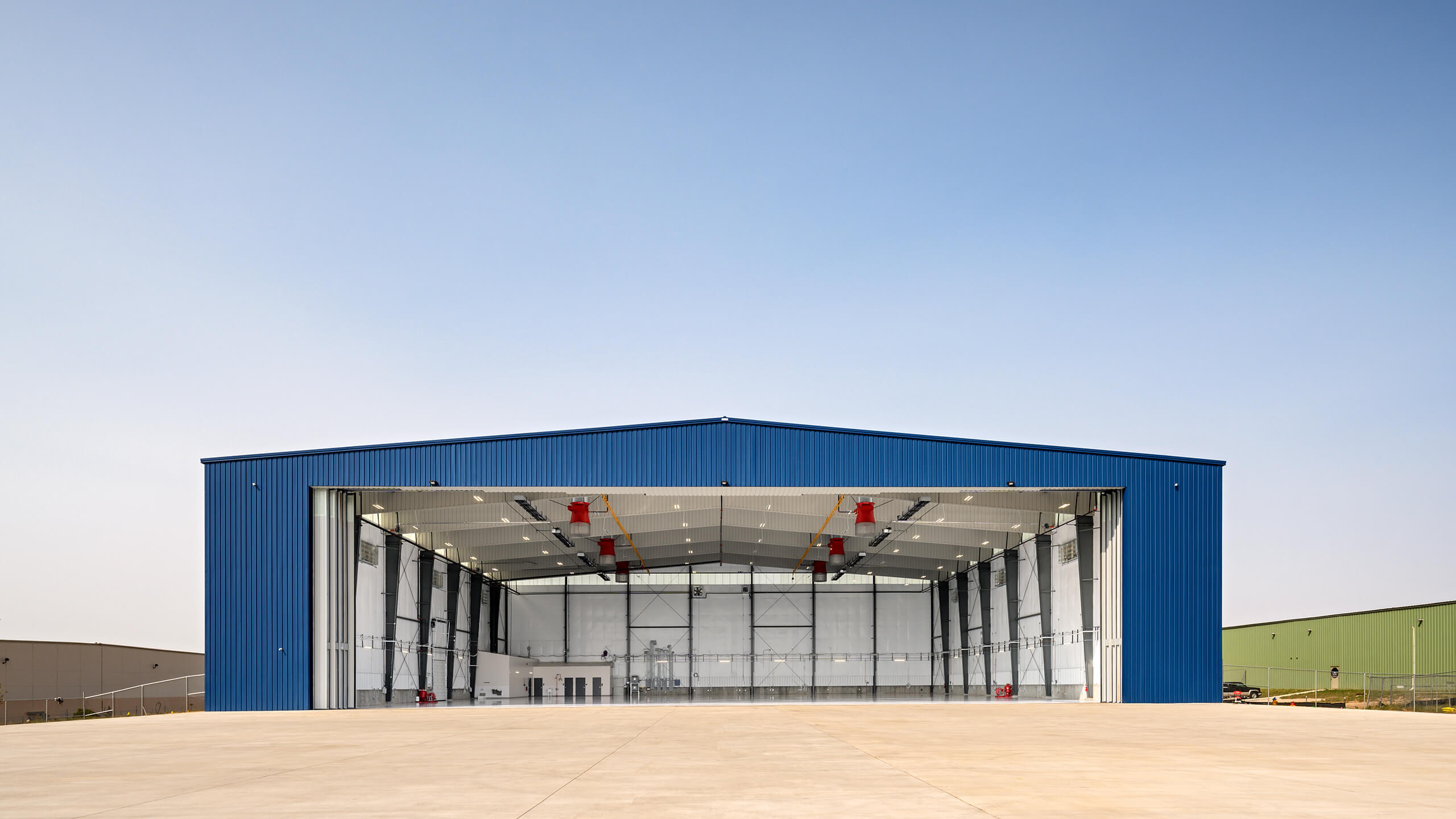
Major Aerospace and Defense Facilities in the Omaha Area
- Offutt Air Force Base / US Strategic Command HQ (Air Force Strategic Command) — Home of US Strategic Command (USSTRATCOM) — the command responsible for US nuclear deterrence operations — with the E-4B Nightwatch 'doomsday plane' and B-2 periodic staging operations
- Northrop Grumman – Omaha (Defense Systems) — Northrop Grumman maintains a significant engineering and support presence in Omaha supporting STRATCOM and ICBM programs
Offutt AFB's strategic command facilities — from the STRATCOM headquarters building to E-4B hangars and secure underground communications structures — represent some of the most sensitive and specification-intensive federal facility roofing work in the Great Plains, in a climate with significant tornado and extreme weather exposure.
The roofing systems on aerospace and defense structures carry stakes beyond weather protection. A failure over an active manufacturing floor — whether that means a fighter jet assembly line, a missile guidance lab, or a satellite integration cleanroom — can trigger production shutdowns, contaminate precision components, or compromise facility certifications. The zero-tolerance standard these clients apply to their primary mission is the same standard we apply to the roof above it.
Our defense and aerospace roofing work includes planned replacement, emergency roof repair under time-critical operational constraints, and new construction roofing for facility expansions. We carry the insurance coverage, bonding capacity, and documented quality procedures that federal facility managers and prime contractor subcontract teams require. When a facility expansion schedule is tied to a DOD delivery milestone, "we'll get to it" is not a close-out answer — we staff to the schedule and document every phase.
Aerospace & Defense Roofing Questions
Yes. We work with facility security officers to complete the necessary base access credentialing for our crew members. Lead time for clearance varies by installation — we factor it into the project schedule upfront rather than discovering it during mobilization.
We provide full prevailing wage certified payroll (if applicable), material submittals for spec compliance, daily logs, third-party inspection coordination, LEED or sustainability documentation if required, and a final warranty package formatted for federal facility records systems.
We develop a phased work plan with the facility manager and base operations officer — sectioning the roof into work zones, maintaining dry-in protection on any open sections, and scheduling loud or disruptive work during approved windows. Our pre-construction checklist includes noise, vibration, dust, and chemical exposure considerations for every zone adjacent to active operations.
We work on the building envelope — roofs, walls, and flashings — which in most cases does not require classified access. For facilities where roof access itself requires a clearance, we identify that requirement early and work with the government contracting officer to plan accordingly.
TPO and PVC membrane systems are most common for new and re-roofing work due to their resistance to chemical splash and UV degradation. Standing seam metal is preferred on high-bay structures where long-term performance and minimal maintenance are prioritized. We always match the system to the specific exposure — a satellite integration cleanroom has different requirements than a motor pool.
Healthcare campuses are the most technically demanding commercial roofing environments in Omaha. The University of Nebraska Medical Center and Nebraska Medicine operate a hospital complex directly beneath roofs that, on any given day, are above active surgical suites, Level I trauma bays, NICU floors, and sterile processing areas. CHI Health's Creighton University Medical Center sits in north Omaha with a similar operational profile. Methodist Health System operates hospital and medical office buildings across the metro from its Midtown campus on Methodist Plaza Drive.
I ran my first hospital roofing project without a detailed infection control plan and learned exactly why that matters. A section of mechanically attached TPO on a hospital wing generates vibration through the deck that can affect sensitive medical equipment on the floor below. Construction dust infiltrating a rooftop HVAC unit on an infection-control floor creates a compliance problem for the infection control officer, not just a maintenance call. Every healthcare roofing project we take requires a written infection control risk assessment (ICRA) submitted to the facility's infection control officer before mobilization — this is not a value-add we offer, it is a non-negotiable precondition for working on an occupied hospital building.
Our project managers have built relationships with facility management teams at UNMC, CHI Health, and Methodist over years of work at these campuses. That continuity — knowing the building's operational schedule, the infection control officer's requirements, and the hot-work permit process specific to each campus — is the thing that prevents a roofing project from becoming a facilities management crisis.
Nebraska Medicine and UNMC Campus
The UNMC campus south of Dodge between 40th and 45th Streets is one of the most complex roofing environments in the Omaha metro. The campus includes The Nebraska Medical Center tower, Clarkson Tower, the Lied Transplant Center, the Fred & Pamela Buffett Cancer Center, and multiple research and academic buildings — each with its own operational profile and construction access protocol.
Work on UNMC's occupied medical buildings requires ICRA submission, hot-work permits coordinated with the campus fire safety office, rooftop HVAC and exhaust system isolation planning (critical on buildings with air handling systems serving operating rooms or immunocompromised patient floors), and a construction noise schedule coordinated against the surgical and patient care schedule. We maintain a written project execution protocol for UNMC campus work that addresses each of these requirements — our project managers are not learning the campus process on your project.
CHI Health — Creighton University Medical Center and Regional Network
CHI Health's Omaha hospital network anchors at Creighton University Medical Center in north Omaha and extends through a regional network of hospitals, specialty clinics, and medical office buildings. The north Omaha campus presents roofing access and staging conditions that require attention: the surrounding neighborhood, parking constraints, and the proximity of active emergency department operations to contractor staging areas.
Medical office buildings in CHI Health's network — including those on the Lakeside, Midlands, and Bergan Mercy campuses — are often managed separately from the main hospital and have different facility management contacts and construction approval processes. We maintain separate project files for each building in a health system's portfolio, and we never assume that access protocols from one building apply to the next.
Infection Control, Hot-Work, and Zero-Shutdown Protocols
Infection Control Risk Assessment (ICRA): Required before mobilization on any occupied hospital building or building connected via HVAC to occupied patient-care space. We complete ICRA documentation and submit to the facility's infection control officer. The ICRA specifies dust containment strategy, HVAC isolation during construction activity, negative air pressure maintenance in affected areas if required, and construction waste removal route that does not cross patient-care corridors.
Hot-work permits: Torch-applied modified bitumen and open-flame welding work requires a hot-work permit on every occupied hospital campus. We submit the permit application with fire watch protocol, fire extinguisher placement plan, suppression system coordination, and daily sign-off sheet. On several UNMC and CHI Health buildings, we have shifted entirely to cold-applied and mechanically attached systems to eliminate hot-work exposure — a design decision that reduces permit complexity and operational risk.
Noise and vibration scheduling: Mechanical attachment of single-ply membrane involves pneumatic screw installation — a noise and vibration source that can affect sensitive floors below. We schedule mechanically attached work against the floor's operational calendar, avoid early morning and late evening noise windows near patient floors, and use vibration-dampened installation equipment where the floor sensitivity requires it.
Frequently asked questions
What is an ICRA and do you produce one?
An Infection Control Risk Assessment is a pre-construction document that identifies infection control risks from the construction activity and specifies mitigation measures — dust containment, HVAC isolation, air pressure management, waste removal routing. We produce ICRA documentation for every project on an occupied healthcare campus and submit it to the facility's infection control officer before mobilization. This is a requirement of Joint Commission standards for construction on healthcare campuses, not a contractor option.
Can roofing work continue while the operating rooms below are active?
It depends on the specific work type and the floor sensitivity. Mechanical attachment of membrane generates vibration and noise — we schedule this away from active OR hours. Cold-applied or fully adhered systems significantly reduce vibration and are preferred over OR and NICU floors. The pre-construction meeting with facility management determines which work types can run during which hours, and that schedule is written into the project execution plan before any crew mobilizes.
Do you have experience with energy-code compliance on UNMC campus buildings?
Yes. UNMC campus buildings are subject to Nebraska energy code (IECC 2021) and in some cases to additional federal requirements for federally funded research facilities. Our insulation specs include compliance documentation for the applicable code path — we do not leave energy code compliance as a field decision.
Roofing scope for a healthcare campus in Omaha?
We will walk the building, complete an ICRA pre-assessment, and produce a written scope with infection control protocol, hot-work plan, and manufacturer warranty path.
Ready to talk through a roof?
Tell us about the building and the roof problem. We'll document it and put a plan in writing — with an honest repair-vs-replace recommendation and no upsell pressure.