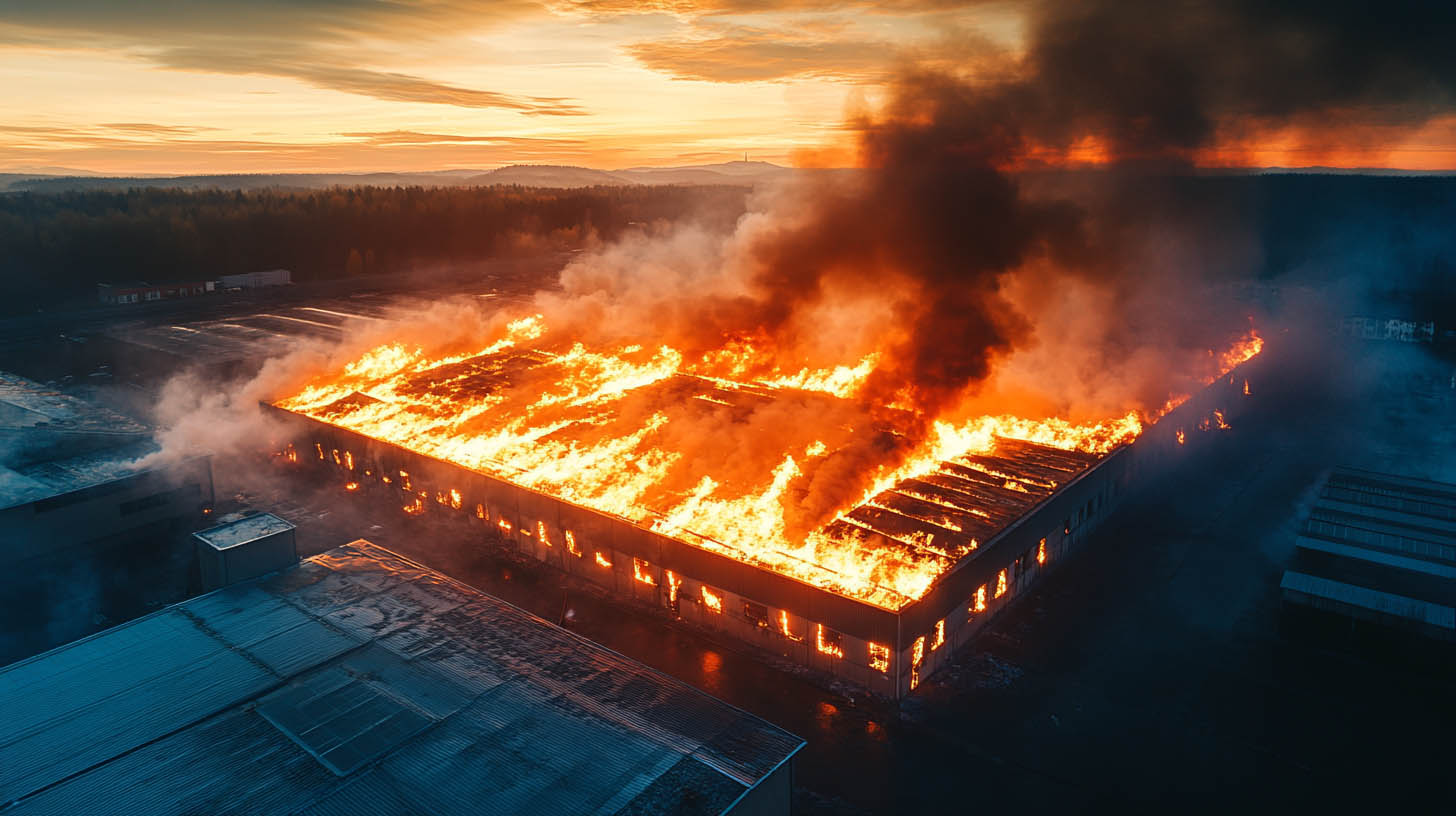
A commercial fire event damages roofs in three ways: direct combustion at the fire origin, heat exposure across a wider zone that destroys membrane adhesion and insulation, and fire suppression water that saturates the roof assembly and produces secondary moisture damage that outlasts the visible fire damage by months.
Commercial fire events in Omaha produce roof damage in a sequence that unfolds over weeks, not hours. The fire itself burns the membrane, the decking, and the insulation in the origin zone. The suppression water from the fire department's operation saturates the insulation throughout the broader affected area — often three to four times the square footage of the direct burn zone. Then, as the building dries and the insurance claim gets underway, the heat-affected membrane beyond the burn zone begins to fail: adhesives that were liquefied by proximity to the fire reharden in a compromised state, seams that were thermally stressed separate under the first freeze-thaw cycle, and modified bitumen systems that received indirect heat exposure develop alligatoring and blistering.
We have inspected commercial roofs in Omaha after fire events in warehouse buildings along the I-80 corridor, after commercial kitchen fires in restaurant buildings in the Aksarben and Midtown corridors, and after the electrical fire events that occur in the mechanical penthouse spaces of older Downtown office buildings. The post-fire inspection protocol is not the same as a storm damage inspection — the failure modes are different, and the documentation requirements for fire claims are specific.
We coordinate with the building owner's fire investigator and the insurance adjuster's team to ensure our inspection produces documentation that is additive to — not duplicative of — the fire investigation. The fire investigator establishes origin and cause. We establish roof system condition across the full affected area.
How Fire Damages Commercial Roof Systems in Omaha
Direct burn zone: Membrane is consumed or carbonized. Insulation is reduced to structural waste — polyiso chars, EPS melts, mineral wool retains structural form but loses thermal value. Metal deck panels in the direct burn zone are assessed for structural capacity — heat beyond approximately 1100°F permanently reduces steel's yield strength. We flag any deck panel that shows paint incineration and severe warping for structural engineer review before crews access the zone.
Heat-affected zone: Extends two to four times the direct burn radius depending on the intensity and duration of the fire. TPO membrane in the heat-affected zone loses its plasticizers at elevated temperatures and becomes brittle — it may look intact on the day of inspection but fail under the first temperature swing. Seam welds in the heat-affected zone are thermally disrupted — the weld bond is degraded even if the seam appears closed. EPDM in the heat-affected zone shows visible surface cracking when heat exposure exceeds the membrane's temperature tolerance. Modified bitumen softens at approximately 200°F and then rehardened in a blistered, delaminated state.
Fire suppression water saturation: The volume of water used in commercial fire suppression often exceeds the volume that penetrates in the worst storm event. We core-test in a grid across the entire roof area above the fire-affected building section — not just in the visible damage zone. Buildings with significant fire suppression water discharge on the roof routinely show insulation moisture content above 50% across areas four to five times the direct damage footprint.
Post-Fire Inspection and Structural Clearance
No crew access without structural clearance: Commercial fires in the direct burn zone can compromise deck attachment, penthouse wall structural integrity, and parapet stability. Our protocol is identical to post-tornado inspection: we do not put project managers on the roof above a fire-affected zone without a licensed Nebraska PE's written clearance. The clearance document is included in the insurance documentation package.
Inspection scope: Once cleared, we conduct a full roof walk with a photo-documented zone diagram. We record every visible membrane failure, every seam separation in the heat-affected zone, every area of suppression water ponding indicated by tide marks, and every penetration boot and flashing in the fire-affected section. We then pull moisture cores in a grid at 15-foot spacing across the full affected area — more tightly spaced in the direct burn and suppression water zones.
Documentation for fire insurance: Fire claims require the repair scope to distinguish between direct damage (covered), heat-affected damage (covered), suppression water damage (generally covered), and pre-existing conditions (not covered). We write our post-fire inspection reports with that distinction explicitly made — it reduces the back-and-forth with the adjuster's team on scope allocation.
Repair Sequencing After Commercial Fire
Emergency weatherization: If the fire has created open holes in the roof deck, immediate weatherization is required before rain event. This is typically EPDM or TPO temporary membrane over plywood decking placed across the open hole, secured at the perimeter with batten boards. Not a repair — a 72-hour bridge to structural assessment and scope development.
Structural work first: Deck panels with compromised structural capacity must be replaced before any roof membrane work proceeds. The deck replacement is coordinated between the structural engineer, the general contractor handling the interior rebuild, and our crew. We sequence roof membrane work to follow deck completion — not to overlap with structural work below.
Phased replacement: Fire-damaged commercial roof replacement in Omaha is typically phased by zone. The direct burn zone, the heat-affected zone, and the suppression water zone may have different replacement scopes and different insulation replacement depths — phasing by zone controls the work sequence and allows the interior rebuild to proceed in parallel with the roof replacement.
Frequently asked questions
Can our building re-open before the roof is fully repaired after a fire?
Partial re-occupancy is possible if the fire-affected zone is isolated from the occupied area and the roof above the occupied area is weathertight and structurally cleared. We work with the building owner's general contractor and the structural engineer to identify which roof sections are cleared for re-occupancy and which require active exclusion. Fire department and city occupancy permit requirements govern re-occupancy timing — we provide written roof condition documentation to support the occupancy permit application.
How long does commercial fire damage roof repair take in Omaha?
Structural clearance and scope development: one to two weeks. Permitting: two to three weeks for City of Omaha permits on fire-damaged buildings. Roof replacement production: two to six weeks depending on scope. Total elapsed time from fire event to closed-out roof: typically eight to twelve weeks for a mid-size commercial building. Insurance claim processing may extend the timeline if there is a dispute on the scope.
Do you coordinate with the fire investigation team?
Yes. We contact the building owner's public adjuster or attorney before our inspection and ensure our investigation does not disturb any fire investigation evidence that is still being preserved. After fire investigation is complete and the site is released, we proceed with the roof inspection. Our project manager's contact on every post-fire project is the building owner — we do not communicate directly with the fire investigator's team without the owner's authorization.
Commercial fire damage roof assessment in Omaha?
We coordinate structural clearance, conduct a full post-fire roof inspection, and produce a written repair scope with zone-level documentation for insurance submission.
Ready to talk through a roof?
Tell us about the building and the roof problem. We'll document it and put a plan in writing — with an honest repair-vs-replace recommendation and no upsell pressure.